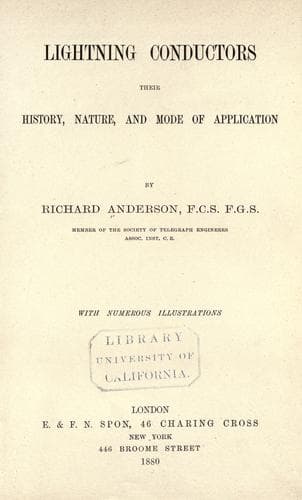
Lightning Conductors: Their History, Nature, and Mode of ApplicationAnderson, Richard, F.C.S.
History
Lightning Conductors: Their History, Nature, and Mode of Application
Anderson, Richard, F.C.S.
Lightning conductors
this opportunity of publishing in the ‘Philosophical Transactions’
a detailed account of the effects of lightning upon St. Bride’s
steeple, explaining the potency of conductors in the very action of the
electric force. He showed how the lightning first struck the metallic
weathercock at the top of the steeple, and ran down, without injuring
anything, the large iron bars by which it was supported. At the bottom
of the bars, the electric force shattered a number of huge stones into
fragments, to make its way to some other pieces of iron, inserted into
the walls to give them strength. So it went on till there were no more
metals, when havoc and destruction became the greatest. Thus, as Dr.
Watson conclusively proved, the beautiful steeple of St. Bride was
wilfully made over to ruin for want of a few hundred yards of iron, or
other metal, which would lead the electric force harmlessly from the
weathercock on the summit into the earth. He finished by telling in
the plainest terms, to all on whom devolved the duty of taking care of
churches, that it was neglectful, even to criminality, not to protect
them by conductors against the always imminent danger of being struck
by lightning.
The lay-sermon of Dr. Watson, deeply impressive by the power of the
indisputable facts on which it was based, had a considerable effect
in rousing public opinion, finding its way even into the dull ears of
‘such as commonly compose church vestries.’ Among the most important
results was a step taken, after long and solemn deliberations,
extending over several years, by the Dean and Chapter of St. Paul’s.
They made an application to the Royal Society, asking for advice as
to the best means of protecting the great cathedral, Sir Christopher
Wren’s noblest creation, against the perils of lightning. The
application was made on March 22, 1769, as recorded under that date in
the ‘Gentleman’s Magazine.’ ‘A letter from the Dean and Chapter of St.
Paul’s,’ it was stated, ‘was read at the Royal Society, requesting the
direction of that learned body for the sudden effects of lightning.
It was referred to a committee consisting of Dr. Franklyn (_sic_),
Dr. Watson, Mr. Canton, Mr. Edward Delaval, and Mr. Wilson, who,
after having examined the building, are to report their opinion.’ The
committee thus nominated embraced all the most eminent men of the
day who had studied the phenomena of electricity, and in the order
in which they ranked. Next to the great discoverer of the lightning
conductor himself, Dr. Watson could claim to stand; and next to him Mr.
John Canton, a most painstaking and intelligent worker in the field,
inventor of the pith-ball electrometer, and other instruments.
Public-domain text, read in full here on John Shaqi.
Reviews
Reviews
No reviews yet
Be the first to share your thoughts on this work.
Join the Discussion
Join the discussion
Sign in to leave a comment or review.
Sign InorCreate an account