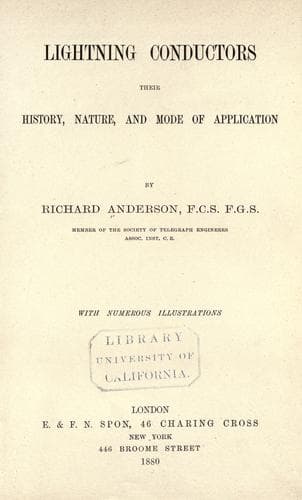
Lightning Conductors: Their History, Nature, and Mode of ApplicationAnderson, Richard, F.C.S.
History
Lightning Conductors: Their History, Nature, and Mode of Application
Anderson, Richard, F.C.S.
Lightning conductors
a period, it has not been found by experience, that places within
the reach of such blessed sound are safer than others where it is
never heard, but that, on the contrary, the lightning seems to strike
steeples by choice, and at the very time the bells are ringing, yet
still they continue to bless the new bells, and jangle the old ones
whenever it thunders.’
‘One would think,’ continues Dr. Franklin, with exquisite humour,
‘that it was now time to try some other trick. Ours is recommended,
whatever the able French philosopher may say to the contrary, by more
than twelve years’ experience, during which, among the great number of
houses furnished with iron rods in North America, not one so guarded
has been materially hurt by lightning, and many have been evidently
preserved by their means; while a number of houses, churches, barns,
ships, &c., in different places, unprovided with rods, have been struck
and greatly damaged, demolished, or burnt. Probably, the vestries of
English churches are not generally well acquainted with these facts;
otherwise, since as good Protestants they have no faith in the blessing
of bells, they would be less excusable in not providing this other
security for their respective churches, and for the good people that
may happen to be assembled in them during a tempest, especially as
these buildings, from their greater height, are more exposed to the
stroke of lightning than our common dwellings.’
While Franklin thus wrote of ‘the great number of houses furnished with
iron rods in North America,’ there was not a single public building
so protected in England. Several private persons had adopted them for
their houses, following the example of Dr. William Watson--subsequently
Sir William--vice-president of the Royal Society, who had been the
first to set up a lightning conductor in England, erecting one over
his cottage at Payneshill, near London, in 1762. But notwithstanding
the evident utility of the ‘Franklin rods,’ they were refused where
they were most wanted--for larger buildings, and particularly for
churches. The ‘unlearned men, such as commonly compose our church
vestries,’ openly declared against them, and among the clergy there
was a steady, if often silent, antagonism to their introduction. The
first movement towards its being upset was given by an occurrence which
caused much commotion, and gave rise to a vast amount of discussion.
On Sunday, June 18, 1764, a few minutes before three in the afternoon,
the splendid steeple of St. Bride’s Church, in the city of London, one
of the architectural monuments of Sir Christopher Wren, was struck by
lightning, the flash being intensely vivid, blinding several people.
The damage done was so serious that about ninety feet of the steeple
had to be taken down entirely, while great and expensive repairs
were required for the rest. Dr. Watson, as the first introducer, so
one of the chief promoters of Franklin’s invention in England, took
Public-domain text, read in full here on John Shaqi.
Reviews
Reviews
No reviews yet
Be the first to share your thoughts on this work.
Join the Discussion
Join the discussion
Sign in to leave a comment or review.
Sign InorCreate an account