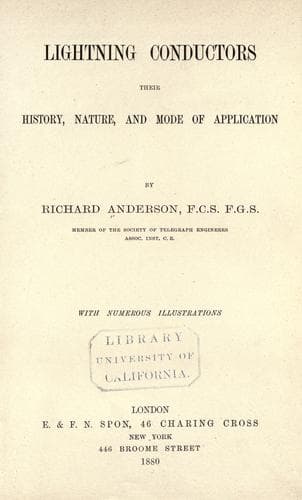
Lightning Conductors: Their History, Nature, and Mode of ApplicationAnderson, Richard, F.C.S.
History
Lightning Conductors: Their History, Nature, and Mode of Application
Anderson, Richard, F.C.S.
Lightning conductors
There was a most remarkable historical concurrence between the gradual
introduction of lightning conductors into Europe and that of the art of
vaccination. Both the great scientific discoveries had the same end in
view for the benefit of mankind, the one teaching the art of drawing
the dangerous electric fire of the clouds harmlessly into the earth,
and the other that of extracting the poisonous seed of disease from
the human body. Both were brought forward with the noblest intentions;
and both encountered the most violent opposition from religious
fanatics, the same in substance, as interfering with the decrees of
Providence, and the ordained wrath of heaven. Both triumphed in the
end, and almost exactly at the same time, though the battle of the
great medical discovery lasted longer, and was more fiercely fought
than that of Franklin’s invention. To make the analogy between the
progress of lightning conductors and of vaccination complete, it so
happened that in at least one conspicuous instance the same man was
an important agent in forwarding the success of both discoveries. The
person in question was Dr. Johan Ingenhousz, a native of Breda, in the
Netherlands, born in 1730. A man of great natural gifts, he came to
England when about thirty years of age, practising as a physician, and
attending specially to the so-called Suttonian method of inoculation
against the small-pox, then an entirely new branch of medical science.
At the same time he eagerly embarked in electrical experiments, got
into correspondence with Benjamin Franklin, and, having made many
friends, was elected a fellow of the Royal Society in 1769. Recommended
to the king, Dr. Ingenhousz became a favourite at court, owing chiefly
to his perfect knowledge of German, which resulted in his being
recommended to a highly profitable as well as distinguished mission.
The famous Imperial lady, the Elizabeth of her age, Maria Theresa of
Austria, had read of the benefits of vaccination, then chiefly known in
England, and wishing to confer them on her own family and friends, she
asked King George the Third to recommend to her some able physician,
who could come to Vienna for the purpose. His Majesty at once named Dr.
Johan Ingenhousz, a recommendation warmly supported by the President of
the Royal Society, Sir John Pringle, who had taken an affection for the
young Dutch physician on account of his electrical researches, which
had resulted in the invention of a novel apparatus, subsequently known
as the plate electrical machine.
Public-domain text, read in full here on John Shaqi.
Reviews
Reviews
No reviews yet
Be the first to share your thoughts on this work.
Join the Discussion
Join the discussion
Sign in to leave a comment or review.
Sign InorCreate an account