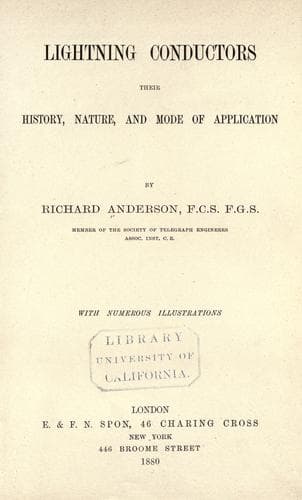
Lightning Conductors: Their History, Nature, and Mode of ApplicationAnderson, Richard, F.C.S.
History
Lightning Conductors: Their History, Nature, and Mode of Application
Anderson, Richard, F.C.S.
Lightning conductors
Dr. Ingenhousz set out for Vienna in 1772, was received with marked
honours by the great Empress, and having done his work, and wishing to
visit Italy, received an autograph letter of Maria Theresa to her son,
Grand Duke Leopold of Tuscany. At the court of this enlightened prince,
Dr. Ingenhousz resided for some time, practising vaccination, but also
engaged in electrical experiments, which created the greatest interest.
It was partly by his advice that the Grand Duke consented, in the
teeth of desperate priestly opposition, to erect one of Franklin’s
lightning conductors over his own palace, and to set them up likewise
for the protection of all the powder magazines in Tuscany. This done,
Dr. Ingenhousz went forward to Padua, invited by some of the professors
of the university, and by the famous senator of Venice, Angelo Querini,
who had a magnificent palace in the neighbourhood of the city. In this
palace, bearing the name of Altichiera, the ‘English doctor,’ as he
was called, was made to reside, practising vaccination, the same as
at the court of Florence, but following as a favourite occupation the
setting-up of ‘heretical rods.’ Altichiera itself had the first erected
in May 1774, and soon after Dr. Ingenhousz had the satisfaction of
planting another over the astronomical observatory of the university
of Padua, in the presence of an enormous crowd of students who lustily
applauded, and of an angry multitude, kept in the background less by
persuasion than the strong arms of the young men. As at Siena, so at
Padua, the mob became pacified not long after by seeing the lightning
fall upon the observatory, much exposed by its situation, and which had
often been struck before, without doing the least damage. From Padua,
Dr. Ingenhousz went to Venice, in company of his friend and patron,
Senator Angelo Querini. Here his efforts to spread the knowledge of
lightning conductors, together with vaccination, had the best results.
The church of St. Mark and other public buildings were surmounted
before long by the awe-striking ‘heretical rods,’ and on May 9, 1778,
the Senate of Venice issued a decree ordering the erection of lightning
conductors throughout the republic. It was the first recognition of the
value of conductors by any government of Europe, or, indeed, of the
world.
CHAPTER V.
METALS AS CONDUCTORS OF ELECTRICITY.
Public-domain text, read in full here on John Shaqi.
Reviews
Reviews
No reviews yet
Be the first to share your thoughts on this work.
Join the Discussion
Join the discussion
Sign in to leave a comment or review.
Sign InorCreate an account