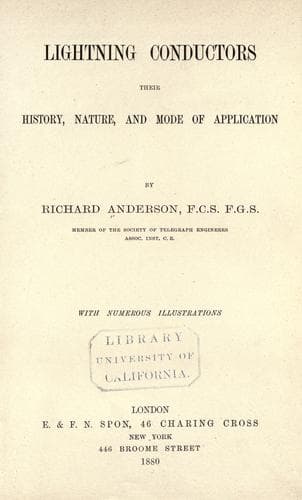
Lightning Conductors: Their History, Nature, and Mode of Application — John Shaqi
Lightning Conductors: Their History, Nature, and Mode of ApplicationAnderson, Richard, F.C.S.
History
Lightning Conductors: Their History, Nature, and Mode of Application
Anderson, Richard, F.C.S.
Lightning conductors
It will be seen, in comparing this statement with the result of the
investigations of Sir Humphrey Davy, that while the latter places
silver before copper in conductivity, Becquerel puts copper at the
head of the list. Probably, the explanation of this difference in the
result of scientific research, by two men equally learned and equally
able, may be found in the fact that the conductivity of copper varies
greatly according to the purity of the metal. It has been ascertained
that absolutely pure copper of the finest kind--such as that existing
in the Isle of Cyprus, youngest of mother Britannia’s colonial
children--has a conducting power of upwards of twenty per cent. more
than the ordinary copper of commerce. While thus arriving at different
estimates, Sir Humphrey Davy and Becquerel are singularly in agreement
in one important respect: they both make the relative electrical
conductivity of copper and iron about the same, placing it, the one a
little under, and the other a little over 100 to 15. In other words,
they both say that the value of copper as a lightning conductor to iron
is as twenty to three, or between six and seven times as great.
Among a host of other investigators of the subject there stand
forward, besides Sir Humphrey Davy and Antoine Becquerel, two Germans,
Professors Lenz and Ohm, and another French savant, Claude Pouillet. In
the opinion of many scientific authorities, especially in the United
States, the experiments of Professor Lenz regarding the comparative
electrical conductivity of different metals were more carefully made
than any other, and are therefore deserving of the greatest credit.
He had, indeed, ample means and great leisure at his disposal, making
his scientific investigations under the patronage of the Grand Duke,
afterwards Emperor, Nicholas of Russia, while acting as his private
tutor at the university of St. Petersburg. The researches of Professor
Lenz as to the comparative power of various metals to conduct the
electric force were given in the following results--copper, as before,
standing as the centesimal unit:—
Silver 136·25
Copper 100·00
Gold 79·80
Tin 30·84
Brass 29·33
Iron 17·74
Lead 14·62
Platinum 14·16
Public-domain text, read in full here on John Shaqi.
Reviews
Reviews
No reviews yet
Be the first to share your thoughts on this work.
Join the Discussion
Join the discussion
Sign in to leave a comment or review.
Sign InorCreate an account