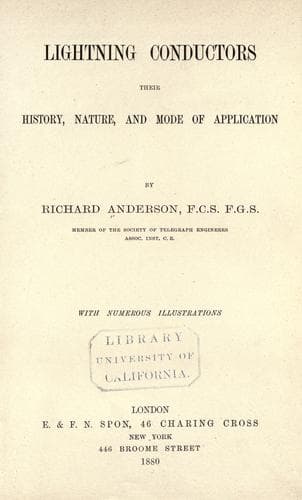
Lightning Conductors: Their History, Nature, and Mode of ApplicationAnderson, Richard, F.C.S.
History
Lightning Conductors: Their History, Nature, and Mode of Application
Anderson, Richard, F.C.S.
Lightning conductors
conductivity of the seven metals:—
Silver 109·10
Copper 100·00
Gold 72·70
Lead 69·10
Platinum 18·20
Palladium 16·40
Iron 14·60
The practical result of these experiments was that it came to be
recognised that, among the metals, copper might be employed to
greater advantage as a lightning conductor than iron: a much lesser
substance of it doing the same service of passing a given quantity of
electricity from the clouds harmlessly into the earth.
Sir Humphrey Davy was followed in his researches on the conductivity
of the different metals by the electric force, by a number of other
scientific men. His immediate successor in entering upon this line
of observations was a French naturalist of eminence, Antoine C.
Becquerel. Perhaps no man after Benjamin Franklin studied the phenomena
of electricity with such thorough insight, free from all misleading
theoretical delusions, as Becquerel. He was educated at the Polytechnic
School of Paris, and in 1810, at the age of twenty-two, entered the
army as an officer of engineers, but quitted it five years afterwards
with the rank of colonel, to devote himself entirely to scientific
pursuits. Geology and mineralogy first engaged his attention, but he
soon quitted these studies to devote himself, heart and soul, to the
observation of the phenomena of electricity, which fascinated him as
much as they had done Benjamin Franklin. The result was the discovery
of a great many facts previously unknown, making Becquerel, amongst
others, one of the founders of the science of electro-chemistry.
The result of his researches concerning the conducting power of the
electric force by different metals may be stated as follows:
Copper 100·00
Gold 93·60
Silver 73·50
Zinc 28·55
Platinum 16·40
Iron 15·80
Tin 15·50
Lead 8·30
Mercury 3·45
Public-domain text, read in full here on John Shaqi.
Reviews
Reviews
No reviews yet
Be the first to share your thoughts on this work.
Join the Discussion
Join the discussion
Sign in to leave a comment or review.
Sign InorCreate an account