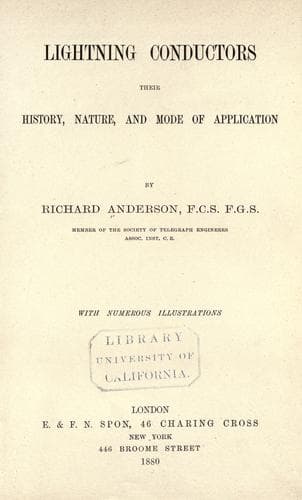
Lightning Conductors: Their History, Nature, and Mode of ApplicationAnderson, Richard, F.C.S.
History
Lightning Conductors: Their History, Nature, and Mode of Application
Anderson, Richard, F.C.S.
Lightning conductors
SPANG (Henry W.) A Practical Treatise on Lightning Protection. 8vo.
Philadelphia, 1877.
SPARKS (Jared). The Works of Benjamin Franklin; with Notes and a
Life of the Author. 10 vols. 8vo. Boston, 1840.
SPRAGUE (John F.) Electricity: its Theory, Sources, and
Applications. 8vo. London, 1875.
STRICKER (Dr. Wilhelm). Der Blitz und seine Wirkungen. 8vo. Berlin,
1872.
STURGEON (William). Lectures on Electricity. 8vo. London, 1842.
TAVERNIER (A. de). Blitzableiter, genannt Anti-Jupiter. 8vo.
Leipzig, 1833.
TINAN (Barbier de). Mémoires sur les Conducteurs pour préserver les
Edifices de la Foudre. 8vo. Strasbourg, 1779.
TOALDO (Giuseppe). Della Maniera di defendere gli Edifizii dal
Fulmine. 8vo. Firenze, 1770.
TOALDO (Giuseppe). Dei Conduttori per preservare gli Edifizii da
Fulmine. 4to. Venezia, 1778.
TOMLINSON (Charles). The Thunderstorm. 8vo. London, 1859.
TYNDALL (John). Notes on Electrical Phenomena. New edition, 8vo.
London, 1876.
VERATTI (J.) Dissertatione de Electricitati cœlesti. 8vo. Bologna,
1755.
WEBER (F. A.) Abhandlung von Gewitter und Gewitterableiter. 8vo.
Zürich, 1792.
WHARTON (W. L.) The Effect of a Lightning Stroke. 8vo. London, 1841.
WILSON (Robert). Boiler and Factory Chimneys; with a chapter on
Lightning Conductors. 8vo. London, 1877.
WINCKLER (Prof. J. H.) Gedanken von den Eigenschaften, Wirkungen
und Ursachen der Elektricität. 8vo. Leipzig, 1744.
YELIN (J. C. von). Ueber die Blitzableiter aus
Messingdrahtstricken. 8vo. München, 1824.
LIGHTNING CONDUCTORS:
THEIR
HISTORY, NATURE, AND MODE OF APPLICATION.
CHAPTER I.
ELECTRICITY AND LIGHTNING.
‘First let me talk with this philosopher: What is the cause of
thunder?’ asks Shakspeare in ‘King Lear’ but without giving a reply.
The ‘philosopher’ of Shakspeare’s days had no answer to make; nor
had any others long after. From the dawn of history till within
comparatively modern times, thunder and lightning were mysteries to the
human mind; nor did there exist so much as a surmise that there might
be any connection between them and the equally mysterious agent called
electricity. The latter force indeed revealed itself early to attentive
observers, though in forms very different from those known at the
present time. The Greeks found out that amber, or ‘electron,’ attracted
certain other bodies under friction, and named the force after it; and
the Romans were aware that the shocks discharged by the torpedo fish
were of electrical nature, and they used them for the cure of rheumatic
complaints in the reign of the Emperor Tiberius. Both Greeks and Romans
also observed the sparks emitted, under certain circumstances, from
clothing and from the fur of animals. But this represented the total
sum of knowledge about electricity for ages and ages.
Public-domain text, read in full here on John Shaqi.
Reviews
Reviews
No reviews yet
Be the first to share your thoughts on this work.
Join the Discussion
Join the discussion
Sign in to leave a comment or review.
Sign InorCreate an account