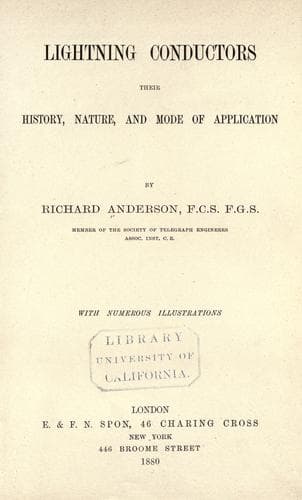
Lightning Conductors: Their History, Nature, and Mode of Application — John Shaqi
Lightning Conductors: Their History, Nature, and Mode of ApplicationAnderson, Richard, F.C.S.
History
Lightning Conductors: Their History, Nature, and Mode of Application
Anderson, Richard, F.C.S.
Lightning conductors
It was not until the year 1600 that Dr. William Gilbert, physician
to Queen Elizabeth, made a great step forward by showing in his
celebrated work, ‘De magnete, magneticisque corporibus, et de magno
magnete tellure, physiologia nova,’ that the two classes of phenomena,
the magnetic and the electric, are emanations of a single fundamental
force pervading all nature. Dr. Gilbert further discovered that many
other substances besides amber possess the electric power, and that
this power is easily excited when the air is dry and cool, and with
difficulty when it is moist and warm. These discoveries caused great
commotion in the European learned world, yet produced no further result
for another half a century. In 1650, Otto von Guericke, burgomaster
of Magdeburg, the inventor of the air-pump, who had studied with
deep interest Dr. Gilbert’s book, succeeded in constructing a little
electrical machine, composed mainly of a ball of sulphur mounted
on a revolving axis. By the aid of this instrument, very rude in
construction, he produced powerful sparks and flashes of electric
light, and it helped him likewise to discover, first, that bodies
excited by friction communicate their electricity to other bodies
by mere contact, and, secondly, that there resides in electrified
substances the power of repulsion as well as that of attraction.
Those who followed in the wake of the ingenious burgomaster of
Magdeburg for the next ninety or hundred years, till towards the middle
of the eighteenth century, did very little towards adding to the
already acquired knowledge of electricity. Sir Isaac Newton constructed
an electrical machine of glass, very superior to that of Otto von
Guericke, with which he made some amusing experiments; but, strangely
enough, drew no conclusions from them, treating the mighty force under
his eyes as only a plaything. This was all the more singular as a
contemporary of the great philosopher, Francis Hauksbee, like him a
Fellow of the Royal Society, called attention, in a volume entitled
‘Physico-mechanical Experiments,’ published in 1709, to the great
similarity between the electric flash and lightning, hinting that the
two might possibly be offspring of the same mysterious force. Dr. Wall,
in 1708, said that the light and crackling of rubbed amber seemed in
some degree to represent thunder and lightning. Another member of the
Royal Society, Stephen Gray--the first man in England who made the
study of electricity the devotion of his life, but of whose career very
little is known beyond the fact that he was very poor, and a pensioner
of the Charterhouse--added numberless experiments to those previously
made, and was bold enough to declare, in 1720, six years before Sir
Isaac Newton’s death, that ‘electricity seems to be of the same nature
with thunder and lightning--if we may compare great things with small.’
For this audacity in ‘comparing things’ he was sharply taken to task by
Public-domain text, read in full here on John Shaqi.
Reviews
Reviews
No reviews yet
Be the first to share your thoughts on this work.
Join the Discussion
Join the discussion
Sign in to leave a comment or review.
Sign InorCreate an account