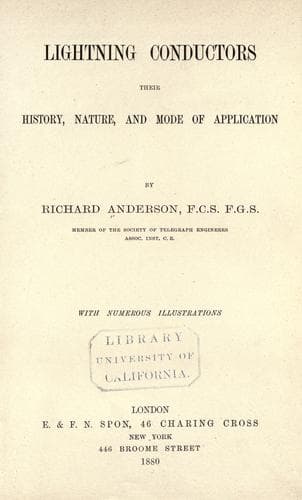
Lightning Conductors: Their History, Nature, and Mode of ApplicationAnderson, Richard, F.C.S.
History
Lightning Conductors: Their History, Nature, and Mode of Application
Anderson, Richard, F.C.S.
Lightning conductors
SIR WILLIAM SNOW HARRIS.
In singular contrast with what took place in France, the importance of
lightning conductors never created any but the most languid interest
in England. Neither the Government, nor any of the scientific bodies
of the country, at any time occupied themselves seriously with the
question as to how public and private buildings might be best protected
against the dangers of thunderstorms; and from the time, a century ago,
when the Royal Society half patronised and half spurned the merits
of Franklin’s discovery, to this day, the battle of science against
ignorance in the matter had to be fought by individuals. With one
exception, that of Sir William Snow Harris, it proved no profitable
battle to any man; and in his case even, it was only so by accident.
Born at Plymouth, in 1792, and educated for the medical profession,
he early turned his attention to the subject of electricity and
lightning conductors, and more particularly to the use of them in the
Royal Navy. Owing to his early surroundings, leading to connection
with naval officers, he learnt that the damages caused by lightning
to ships of war were very numerous, and most expensive to repair; and
having got once hold of these facts, he gave them to the public in
the ‘Nautical Magazine,’ but chiefly in pamphlet form, insisting upon
the simple remedy of lightning conductors. As usual, the Government
lent a deaf ear to the proposal as long as it was possible, and it
was only when at length, in 1839, the outcry upon the subject became
overwhelming, that a naval commission was appointed ‘to investigate the
best method of applying lightning conductors to Her Majesty ships.’
The commission drew up an immense report, filling eighty folio pages
of a blue-book, the kernel of which was that, though such protectors
in thunderstorms were rather new-fangled things, they might be tried
without special harm coming to anybody. Thereupon most of the vessels
received lightning conductors, made after designs by Mr. Snow Harris.
The indefatigable advocate of conductors had his reward. He was
knighted in 1847; he had, at various times, considerable grants from
the Government; and he had the final satisfaction of being allowed
to design lightning conductors for the new Houses of Parliament. The
latter remain the most enduring monument of the only man in this
country who ever succeeded in drawing the attention of the public
and the Government to the grave subject of lightning conductors. He
could not have done so, at least not in the line he took up, had he
lived half a century later. With the gradual disappearance of the old
wooden ships disappeared also the necessity of lightning conductors
for men-of-war. An iron-built vessel, metal-rigged, is a conductor by
itself, while as to armour-clad ships of latest design, they are more
absolutely protected against lightning even than the famous gilded
temple of Solomon at Jerusalem.
Public-domain text, read in full here on John Shaqi.
Reviews
Reviews
No reviews yet
Be the first to share your thoughts on this work.
Elsewhere in the archive
Join the Discussion
Join the discussion
Sign in to leave a comment or review.
Sign InorCreate an account