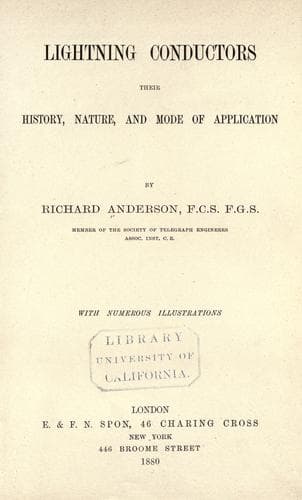
Lightning Conductors: Their History, Nature, and Mode of ApplicationAnderson, Richard, F.C.S.
History
Lightning Conductors: Their History, Nature, and Mode of Application
Anderson, Richard, F.C.S.
Lightning conductors
While designing lightning conductors for the ships of the Royal Navy,
Mr. William Snow Harris was called upon likewise by the Secretary of
State for War to give advice as to the best protection that might
be given to powder magazines and other stores of war material. He
did as requested, writing a very lucid paper on the subject, which
met with the honour, unique in its way, of being put forward as an
official document. To this day there is regularly issued with the
‘Army Circulars’ from the War Office a series of ‘Instructions as
to the Applications of Lightning Conductors for the Protection of
Powder Magazines, &c.,’ reproducing textually the recommendations
of Mr. Snow Harris. These ‘Instructions,’ containing the essence of
what he wrote about conductors, and, in fact, the result of all his
investigations on the subject, treat the whole _ab ovo_, and as such
deserve quotation. ‘Thunder and lightning,’ Mr. Snow Harris wrote to
the War Office, ‘result from the operation of a peculiar natural agency
through an interval of the atmosphere contained between the surface
of a certain area of clouds, and a corresponding area of the earth’s
surface directly opposed to the clouds. It is always to be remembered
that the earth’s surface and the clouds are the terminating planes of
the action, and that buildings are only assailed by lightning because
they are points, as it were in, or form part of, the earth’s surface,
in which the whole action below finally vanishes. Hence, buildings,
under any circumstances, will be always open to strokes of lightning,
and no human power can prevent it, whether having conductors or not, or
whether having metals about them or not, as experience shows.’
Mr. Snow Harris then went on philosophising. ‘Whenever,’ he said, ‘the
peculiar agency--whatever it be--active in this operation of nature,
and characterised by the general term electricity or electric fluid,
is confined to substances which are found to resist its progress,
such, for example, as air, glass, resinous bodies, dry wood, stones,
&c., then an explosive form of action is the result, attended by such
an evolution of light and heat, and by such an enormous expansive
force, that the most compact and massive bodies are rent in pieces,
and inflammable matter ignited. Nothing appears to stand against it:
granite rocks are split open, oak and other trees of enormous size rent
in shivers, and masonry of every kind frequently laid in ruins. The
lower masts of ships of the line, 3 feet in diameter and 110 feet long,
bound with hoops of iron half an inch thick and five inches wide, the
whole weighing about 18 tons, have been in many instances torn asunder,
and the hoops of iron burst open and scattered on the decks. It is, in
fact, this terrible expansive power which we have to dread in cases of
buildings struck by lightning, rather than the actual heat attendant on
the discharge itself.’
Public-domain text, read in full here on John Shaqi.
Reviews
Reviews
No reviews yet
Be the first to share your thoughts on this work.
Elsewhere in the archive
Join the Discussion
Join the discussion
Sign in to leave a comment or review.
Sign InorCreate an account