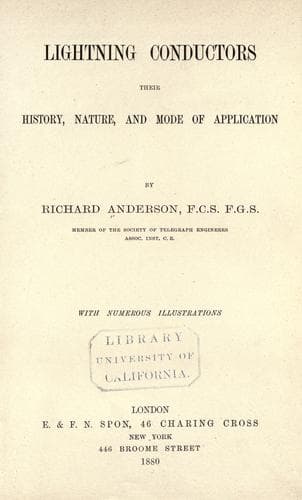
Lightning Conductors: Their History, Nature, and Mode of ApplicationAnderson, Richard, F.C.S.
History
Lightning Conductors: Their History, Nature, and Mode of Application
Anderson, Richard, F.C.S.
Lightning conductors
He continued: ‘When, however, the electrical agency is confined to
bodies, such as the metals, and which are found to oppose but small
resistance to its progress, then this violent expansive or disruptive
action is either greatly reduced or avoided altogether; the explosive
form of action we term lightning vanishes, and becomes, as it were,
transformed into a sort of continuous current action of a comparatively
quiescent kind, which, if the metallic substance it traverses be of
certain _known_ dimensions, will not be productive of any damage to
the metal; if, however, it be of small capacity--as in the case of a
small wire--it may become heated and fused; in this case the electrical
agency, as before, is so resisted in its course as to admit of its
taking on a greater or less degree of explosive and heating effect,
as in the former case. It is to be here observed, that all kinds of
matter oppose some resistance to the progress of what is termed the
electrical discharge, but the resistance through capacious metallic
bodies is comparatively so small as to admit of being neglected under
ordinary circumstances; hence it is, that such bodies have been termed
conductors of electricity, whilst bodies such as air, glass, &c.,
which are found to oppose very considerable resistance to electrical
action, are placed at the opposite extremity of the scale, and termed
non-conductors or insulators. The resistance of a metallic copper wire
to an ordinary electrical discharge from a battery was found so small,
that the shock traversed the wire at the rate of 576,000 miles in a
second. The resistance, however, through a metallic line of conduction,
small as it be, increases with the length, and diminishes with the area
of the section of the conductor, or as the quantity of metal increases.’
Public-domain text, read in full here on John Shaqi.
Reviews
Reviews
No reviews yet
Be the first to share your thoughts on this work.
Elsewhere in the archive
Join the Discussion
Join the discussion
Sign in to leave a comment or review.
Sign InorCreate an account