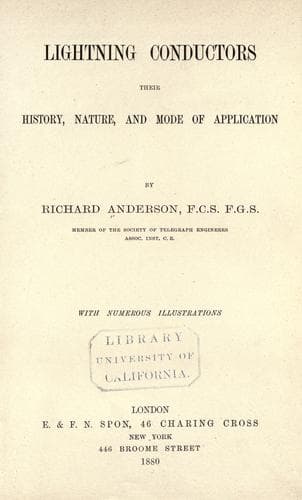
Lightning Conductors: Their History, Nature, and Mode of ApplicationAnderson, Richard, F.C.S.
History
Lightning Conductors: Their History, Nature, and Mode of Application
Anderson, Richard, F.C.S.
Lightning conductors
After these theoretical explanations, Mr. Snow Harris went into the
practical part of the business of protecting buildings, and, more
especially, powder magazines and others containing explosive materials,
against the effects of lightning. ‘It follows,’ he remarked,’from these
established facts, that if a building were metallic in all its parts,
an iron magazine for example, then no damage could possibly arise to
it from any stroke of lightning which has come within the experience
of mankind. A man in armour is safe from damage by lightning. In fact,
from the instant the electrical discharge, in breaking with disruptive
and explosive violence through the resisting air, seizes upon the mass
in any point of it, from that instant the explosive action vanishes,
and the forces in operation are neutralised upon the terminating planes
of action--viz., the surface of the earth and opposed clouds. All this
plainly teaches us that, in order to guard a building effectually
against damage by lightning, we must endeavour to bring the general
structure, as nearly as may be, into that passive or non-resisting
state it would assume, supposing the whole were a mass of metal. To
this end, one or more conducting channels of copper, depending upon the
magnitude and extent of the building, should be systematically applied
to the walls. These conducting channels should consist either of double
copper plates, united in series one over the other, as in the method of
fixing such conductors to the masts of her Majesty’s ships, the plates
being not less than 3½ inches wide, and of 1/16th and ⅛th of an inch
in thickness; or the conductors may with advantage be constructed of
stout copper pipe, not less than 1/16th of an inch thick, and 1½ to 2
inches in diameter; in either case the conductors should be securely
fixed to the walls of the building, either by braces, or copper nails,
or clamps. They should terminate in solid metal rods above, projecting
freely into the air, at a moderate and convenient height above the
point to which they are fixed, and below they should terminate in one
or two branches leading outward about a foot under the surface of the
earth; if possible, they should be connected with a spring of water or
other moist ground. It would be proper, in certain dry situations, to
lead out, in several directions under the ground, old iron or other
metallic chains, so as to expose a large extent of metallic contact in
the surface of the earth.’
Public-domain text, read in full here on John Shaqi.
Reviews
Reviews
No reviews yet
Be the first to share your thoughts on this work.
Elsewhere in the archive
Join the Discussion
Join the discussion
Sign in to leave a comment or review.
Sign InorCreate an account