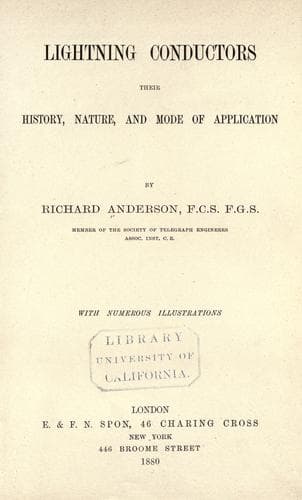
Lightning Conductors: Their History, Nature, and Mode of ApplicationAnderson, Richard, F.C.S.
History
Lightning Conductors: Their History, Nature, and Mode of Application
Anderson, Richard, F.C.S.
Lightning conductors
A few pregnant sentences, which by themselves deserved the honour of
permanently figuring in the ‘Instructions’ sent out by the War Office,
completed the advice given by Mr. William Snow Harris in respect to the
setting up of lightning conductors. ‘A building,’ he truly remarked,
‘may be struck and damaged by lightning without having a particle of
metal in its construction. If there be metals in it, however, and they
happen to be in such situations as will enable them to facilitate the
progress of the electrical discharge, so far as they go, then the
discharge will fall on them in preference to bodies offering more
resistance, but not otherwise. If metallic substances be not present,
or, if present, they happen to occupy places in which they cannot be of
any use in helping on the discharge in the course it wants to go, then
the electricity seizes upon other bodies, which lie in that course,
or which can help it, however small their power of doing so, and in
this attempt such bodies are commonly, but not always, shattered in
pieces.’ He summed up as follows:—‘The great law of the discharge is,
progress between the terminating planes of action--viz., the clouds
and earth--and in such line or lines as, upon the whole, offer the
least mechanical impediment or resistance to this operation, just as
water, falling over the side of a hill in a rain storm, picks out, or
selects as it were by the force of gravity, all the little furrows
or channels which lie convenient to its course, and avoids those
which do not. If in the case of lightning you provide, through the
instrumentality of efficient conductors, a free and uninterrupted
course for the electrical discharge, then it will follow that course
without damage to the general structure; if you do not, then this
irresistible agency will find a course for itself through the edifice
in some line or lines of least resistance to it, and will shake all
imperfect conducting matter in pieces in doing so. Moreover, it is to
be especially remarked in this case, that the damage ensues, not where
the metals are, but where they ceased to be continued; the more metal
in a building, therefore, the better, more especially when connected
by an uninterrupted circuit with any medium of communication with the
earth.’
Public-domain text, read in full here on John Shaqi.
Reviews
Reviews
No reviews yet
Be the first to share your thoughts on this work.
Elsewhere in the archive
Join the Discussion
Join the discussion
Sign in to leave a comment or review.
Sign InorCreate an account