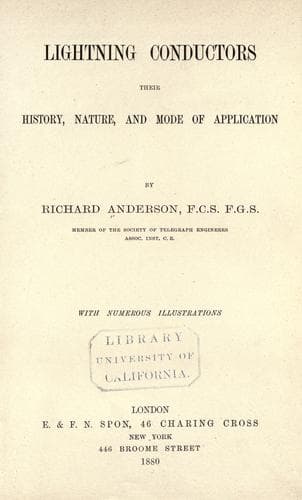
Lightning Conductors: Their History, Nature, and Mode of ApplicationAnderson, Richard, F.C.S.
History
Lightning Conductors: Their History, Nature, and Mode of Application
Anderson, Richard, F.C.S.
Lightning conductors
‘Such is, in fact,’ he concluded, ‘the great condition to be satisfied
in the application of lightning conductors, which is virtually nothing
more than the perfecting a line or lines of small resistance in
given directions, less than the resistance in any other lines in the
building, which can be assigned in any other direction, and in which,
by a law of nature, the electrical agency will move in preference to
any others. The popular objections to lightning conductors on the
ground that they invite lightning to the building, that we do not know
the quantity of electricity in the clouds, and that hence they may
cause destruction, are now quite untenable, and have only arisen out of
a want of knowledge of the nature of electrical action. What should we
think of a person objecting to the use of gutters and rain-pipes for a
house, on the ground of their attracting or inviting a flow of water
upon the building; and since we do not know the amount of rain in the
clouds, it is possible that the building may be thereby inundated,--yet
such is virtually the argument against lightning conductors.’
Mr. Snow Harris, as already mentioned, received the honour of
knighthood in 1847; and after this date lived in comparative retirement
for twenty years at his residence, Windsor Villas, Plymouth. However,
he was called upon, in 1855, to undertake one more important work in
designing a perfect system of lightning conductors for the new Houses
of Parliament at Westminster. It was on the initiative of Sir Charles
Barry, the architect, that the proposal was made by the Board of Works
to Sir William Snow Harris, who accepted it with all his old eagerness
for serving the cause of lightning protection. Accordingly, he drew up
a plan, which he himself characterised, in a letter to the President
of the Board of Works, dated February 14, 1855, as ‘somewhat costly,’
but which he felt sure would be absolutely certain ‘for insuring the
safety of the buildings against one of the most terribly destructive
elements of nature.’ In its essence, the plan consisted in protecting
all the most elevated parts of the Houses of Parliament, including the
towers, by ‘a capacious metallic conductor of copper tube, two inches
in diameter, and not less than one-eighth of an inch in thickness,’ to
be fastened together ‘by solid screw plugs and coupling pieces,’ and
‘secured to the masonry by efficient metallic staples.’ To do this,
Sir William Snow Harris calculated, would involve an expenditure of
somewhat over 2,000_l._, but nothing less would accomplish it. ‘What
I have recommended,’ he wound up his letter, ‘has been the result of
very serious and attentive deliberation, and I conscientiously think
that what I have proposed is absolutely requisite to a permanent
and satisfactory security of the buildings against the destructive
agency of lightning.’ The Board of Works entirely adopted all the
recommendations of Sir William Snow Harris, and, in accordance with
Public-domain text, read in full here on John Shaqi.
Reviews
Reviews
No reviews yet
Be the first to share your thoughts on this work.
Elsewhere in the archive
Join the Discussion
Join the discussion
Sign in to leave a comment or review.
Sign InorCreate an account