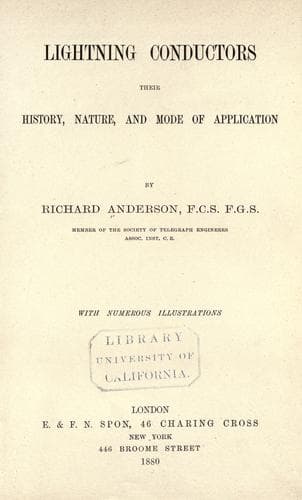
Lightning Conductors: Their History, Nature, and Mode of ApplicationAnderson, Richard, F.C.S.
History
Lightning Conductors: Their History, Nature, and Mode of Application
Anderson, Richard, F.C.S.
Lightning conductors
them, there was included in the Civil Service Estimates laid before the
House of Commons in the session of 1855 a vote of 2,314_l._, on account
of ‘works necessary for securing the new Houses of Parliament against
danger from lightning.’
The vote passed without demur. It was in the height of the Crimean War
fever, political questions absorbing all others. Perhaps in a time
of less excitement some voice might have been raised in the House of
Commons asking whether it was wise to spend over 2,000_l._ in putting
up lightning conductors, without previously ascertaining, from the
best scientific authorities, that the system adopted was the best,
and absolutely efficacious. The strongly recommended ‘copper tubes,’
with their ‘screw plugs and coupling pieces,’ were at least a novelty,
not having stood the test of experience, and there were practical
men who shook their heads when they heard of them. However, with
war discussions raging fiercely, and reports of battles and sieges
absorbing all attention, the House of Commons had no time to bestow
upon such trifling matters as that involved in the plans of Sir William
Snow Harris; and thus the vote passed unchallenged. Perhaps silent
repentance came afterwards to the official mind. At any rate, as it was
the first, so it was the last time of Parliament granting money for
lightning conductors.
[Illustration]
CHAPTER IX.
THE BEST MATERIAL FOR CONDUCTORS.
‘The art of protection against lightning,’ says a recent German
writer, in a book on conductors, ‘is precisely the same now as it was
a hundred years ago: still, it has made immense progress since that
time.’ Though apparently involving a paradox, the words nevertheless
are literally true. The art, or rather science, of guarding objects
against the destructive effects of lightning is theoretically the same
as it was in the days of Benjamin Franklin; nevertheless, the practical
execution of the appliances necessary to attain this aim has undergone
extraordinary improvements since that time. This has been due simply to
the astounding progress of the metallurgical arts for the last forty or
fifty years. With the help of machinery on a colossal scale, such as
was never dreamt of before, our factories have come to produce metallic
masses of dimensions and shapes such as make all former achievements of
the kind appear utterly insignificant. We build huge iron ships, armed
with cannon of ponderous weight; we throw iron bridges across rivers
and arms of the sea; we lay metallic cables through the ocean and over
the earth, encircling the globe. All these wonderful achievements, in
which the development of engineering science went hand in hand with
that of tool-making and the ever-growing employment of the power of
steam, have gone to the constant improvement of lightning conductors.
They have benefited, indirectly, in the result of great inventions, and
of immense toil and labour, originally directed to other ends.
Public-domain text, read in full here on John Shaqi.
Reviews
Reviews
No reviews yet
Be the first to share your thoughts on this work.
Elsewhere in the archive
Join the Discussion
Join the discussion
Sign in to leave a comment or review.
Sign InorCreate an account