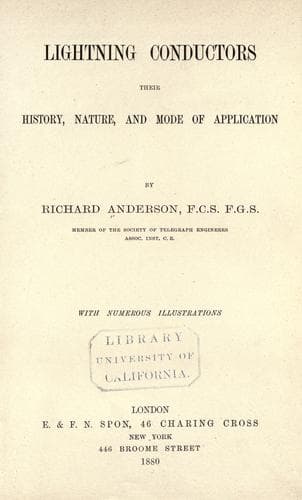
Lightning Conductors: Their History, Nature, and Mode of ApplicationAnderson, Richard, F.C.S.
History
Lightning Conductors: Their History, Nature, and Mode of Application
Anderson, Richard, F.C.S.
Lightning conductors
There is something half touching, half comical, in reading of the
troubles which Benjamin Franklin had to undergo before he was able to
set up his first lightning conductor. He could meet with no assistance
but that of the blacksmith of little Philadelphia; and the ability
of the latter in the art of forging iron rods more than a few feet
in length was of the most limited kind. The ingenuity of Franklin
overcame this difficulty by a variety of clever contrivances, such
as connecting a number of small rods by caps and joints, fitting
closely; but others were not so successful as he in the matter. Even
in Paris there were no artisans to be found, for many years after
lightning conductors were first recommended, able to make them, and
foreigners, chiefly English, had to be brought there for the purpose.
The difficulties arising from this backward state of the industrial
arts were greatly increased by the belief, prevalent for a long time,
that lightning conductors, to be efficient, ought to be of very great
height, their so-called ‘area of protection’ being in proportion to
their height. The supposition, originating in France, was carried to
extremes in that country, chiefly through the teachings of M. J. B.
Le Roy, a very able but eccentric man. Guided by vague analogies in
electrical phenomena, M. Le Roy, who enjoyed in his time--the latter
part of the eighteenth century--the reputation of being an authority on
the subject of lightning conductors, laid it down as an indisputable
fact that the ‘Franklin rods’ only protected buildings if rising high
above them. He recommended the length of the rods above the chimney, or
summit of any edifice, to be not less than fifteen feet, guaranteeing
that, if of this height, they would offer absolute protection against
lightning over an area of four times the same diameter--that is, sixty
feet. Modern experience has proved this to be an absurdity; still,
in the infancy of all knowledge about lightning conductors it was,
perhaps, not unnatural that even learned men should believe in such
fancies. Lightning was looked upon, not only in name but in reality,
as an electric ‘fluid’ and the conductor was supposed to draw this
‘fluid’ from the clouds. Therefore it was but cogent reasoning to raise
conductors as high above the roofs, and as near to the storm-clouds, as
could possibly be done. If possessed of modern means for manufacturing
pieces of metal of almost any length, M. Le Roy would not improbably
have recommended to elevate lightning conductors a couple of hundred
feet, instead of only fifteen, above the summit of buildings.
Public-domain text, read in full here on John Shaqi.
Reviews
Reviews
No reviews yet
Be the first to share your thoughts on this work.
Elsewhere in the archive
Join the Discussion
Join the discussion
Sign in to leave a comment or review.
Sign InorCreate an account