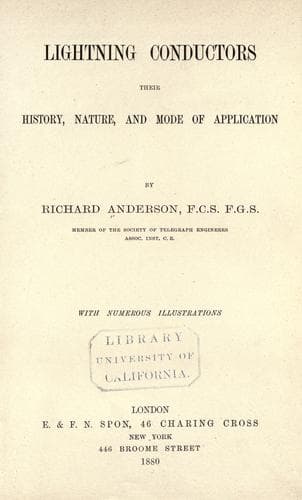
Lightning Conductors: Their History, Nature, and Mode of ApplicationAnderson, Richard, F.C.S.
History
Lightning Conductors: Their History, Nature, and Mode of Application
Anderson, Richard, F.C.S.
Lightning conductors
It was owing chiefly to the difficulty of forging long iron pieces,
and of welding them together in a satisfactory manner, that, for many
years after lightning conductors had been introduced into Europe,
there were constant attempts made to find substitutes for the rods
devised by Franklin. Chains were largely used towards the end of the
last and the beginning of the present century, both in France and
Germany, their employment having been suggested by the example of the
English navy, where they were introduced, as already mentioned, upon
the recommendation of Dr. Watson. The Continental mode of using iron
chains for the protection of buildings against lightning was to hang
them between the upper part of the conductor, surmounting the roof,
which continued to be a straight piece of metal or rod, and the lower
portion buried in the ground, sometimes, but not always, likewise a
chain, but thicker than the rest. The characteristic of this method,
and showing its long existence, is that it gave rise to a nomenclature
existing to this day in France and Germany, where in all books on
lightning conductors they are described as consisting of three distinct
parts. The French call the upper part of the rod, over the roof, ‘_la
tige_,’ the stem or stalk; and the Germans, ‘_die Auffangstange_’
literally the reception-rod. In both languages the middle part,
from the roof downwards to the earth’s surface, is described as the
conductor proper, ‘_le conducteur_’ and ‘_der Leiter_.’ Again, the
lowest underground part of the conductor is designated, by the French,
‘_la racine_,’ the root, and by the Germans as ‘_der Bodenleiter_,’
or the ground-conductor. It has often been said that, as language
springs from ideas, so it reacts upon them, and if the proposition
be true, as most will admit, the French and German designations of
the parts of lightning conductors--also to be found in Italian, and
adopted in a few of the older English treatises on the subject, mostly
translations--have a strongly misleading tendency. Nothing could be
further from the truth than the assertion that a conductor ought to
consist of three distinct parts. On the contrary, the more it is ‘one
and undivided,’ the better it will be as a lightning protector.
Public-domain text, read in full here on John Shaqi.
Reviews
Reviews
No reviews yet
Be the first to share your thoughts on this work.
Elsewhere in the archive
Join the Discussion
Join the discussion
Sign in to leave a comment or review.
Sign InorCreate an account