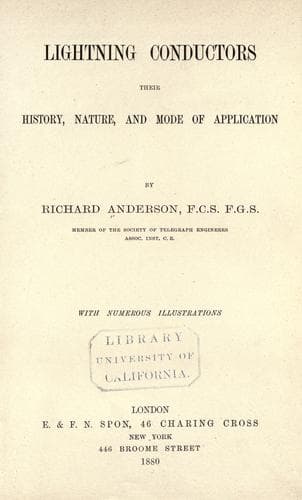
Lightning Conductors: Their History, Nature, and Mode of Application — John Shaqi
Lightning Conductors: Their History, Nature, and Mode of ApplicationAnderson, Richard, F.C.S.
History
Lightning Conductors: Their History, Nature, and Mode of Application
Anderson, Richard, F.C.S.
Lightning conductors
up by declaring that he had become terrified by his own foster-child,
and that he would not submit to another electric shock ‘for the whole
kingdom of France.’
Experiments in electricity now became the prevailing mania. Louis XV.
of France set the fashion among crowned heads of having his soldiers
electrified, to see what benefit he, or they, would derive from it. On
the instigation of Abbé Nollet, considered a man of high scientific
attainments, and who made several important discoveries in electricity,
the King submitted, in his own presence, 180 of the tallest men of his
life-guards, fastened hand to hand by iron wires, to repeated charges
from a connected group of Leyden jars. The big fellows were not visibly
influenced by the electric shocks, experiencing not so much as the
historical nose-bleeding of Professor Winckler of Leipzig, still less
the dumbness of his worthy spouse. On the contrary, the wire-bound
royal guards, conscious of but very slight sensations from the electric
shocks, and feeling somewhat indignant at this, and of being made
scientific tools without at least getting a strong bump on the head,
spoke out strongly, declaring the whole matter to be an imposture.
Having failed to electrify his soldiers, Louis XV. tried his monks.
It struck his Most Christian Majesty that perhaps the human creatures
who had the honour of fighting for him were endowed by nature with
rather tough hides, and that the case might be different in regard
to the softer beings upon whom devolved the task of praying for him.
Accordingly, the King issued orders that all the monks of the grand
convent of the Carthusians at Paris, over 700 in number, should be
electrified by the same connected group of Leyden jars which had
been tried upon the company of life-guards. The result was entirely
different, and most gratifying to the King. The shock had no sooner
been given when the whole file of monks gave an instantaneous jump,
uttering a howl at the same time. There were some eye-witnesses of
the affair who asserted that the Carthusians jumped and howled even
before the shock had been given, on seeing some one approach the Leyden
jar; but this was officially denied. King Louis XV. was so delighted
with this result of his scientific investigations, that he proposed
to submit all the monks of all the monasteries of France successively
to the process of being electrified, so that it might be accurately
ascertained upon what religious orders and communities it took the
greatest effect. His Majesty likewise was pleased to suggest, that,
after all the monks had been electrified, the nuns might be tried in
their turn. But the proposal was vetoed at Rome. There came definite
orders from the Supreme Pontiff forbidding the contact of any more
persons in the service of the holy Catholic Church with the sinful
electric wire; and the Carthusians of Paris remained the last monks,
as they had been the first, brought to jump and howl at the touch of a
Leyden jar.
Public-domain text, read in full here on John Shaqi.
Reviews
Reviews
No reviews yet
Be the first to share your thoughts on this work.
Join the Discussion
Join the discussion
Sign in to leave a comment or review.
Sign InorCreate an account