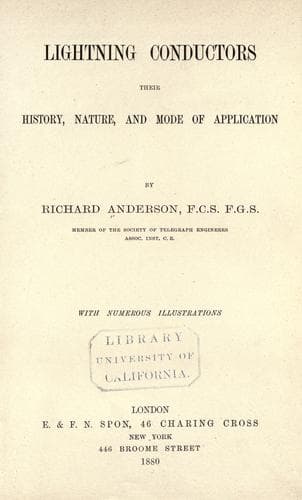
Lightning Conductors: Their History, Nature, and Mode of Application — John Shaqi
Lightning Conductors: Their History, Nature, and Mode of ApplicationAnderson, Richard, F.C.S.
History
Lightning Conductors: Their History, Nature, and Mode of Application
Anderson, Richard, F.C.S.
Lightning conductors
One day Professor Allamand and Van Musschenbroek, together with a pupil
named Cuneus--a sort of Wagner, it would seem, sitting at the feet
of Dr. Faust--were trying the effects of electricity on a small iron
cannon, suspended by silk threads, and connected by a wire with a glass
bottle half full of water, when whey were startled by an extraordinary
incident. Curious, like all students of occult sciences, young Cuneus
took it into his head to see what would happen if he held the prime
conductor of the electrical machine in one hand and the electrified
bottle of water in the other. Something wonderful happened, indeed,
causing profound amazement and terror to the three persons witnessing
it, most of all to the immediate experimenter, who sank down on the
floor, half dead with fright. Master Cuneus had received an electric
shock. It was the first electric shock ever administered by artificial
means to any human being.
Such was the origin of the long-famous ‘Leyden jar,’ or, as it was
originally called, ‘Leyden phial.’ The whole of the scientific world
of Europe was as much startled by the discovery that electricity
could be imprisoned, like Ariel in an oak-tree, as the two Leyden
professors and their pupil had been, and a perfect fury set in for more
experiments. A professor of the University of Leipzig, in Germany, Dr.
Winckler, started the excitement by submitting his body to frequent
powerful shocks, opening up, besides, a scientific discussion in which
he came forth as the champion of the proposition that the discovery
of the ‘Leyden phial’ was due, not to the professors in the Dutch
university, but to a German ecclesiastic, Ewald George von Kleist,
who made the experiments of Messrs. Allamand and Van Musschenbroek a
year before them. His own sensations in submitting to the force of
electric shocks, Professor Winckler described, doubtless with some
exaggeration, as being convulsed from head to toe, and the prey of
violent agitations, which threw his arms about, and made the blood rush
from his nose. Dr. Winckler did not venture upon many experiments; but
his spouse, undismayed by the arm-shaking and nose-bleeding of her
lord, and having the combined curiosity of a woman and a professor’s
wife, continued upon her own person the electric shocks. However,
she did not take many, nor did science gain by the sacrifice. When a
few graspings of the ‘Leyden phial’ had deprived her of the power to
walk, and, what was worse, to speak, she followed the example of her
bleeding husband, and took ‘cooling medicines.’ All these wonderful
facts were made widely known at the time, and created the most profound
interest. Professor Musschenbroek, of Leyden, added not a little to the
prevailing excitement by writing to his friend René Antoine de Réaumur,
inventor of the thermometer named after him, a long letter, given at
once to the public, in which he dwelt upon the terrible effects of the
mysterious agency which he had helped to call into being, and wound
Public-domain text, read in full here on John Shaqi.
Reviews
Reviews
No reviews yet
Be the first to share your thoughts on this work.
Join the Discussion
Join the discussion
Sign in to leave a comment or review.
Sign InorCreate an account