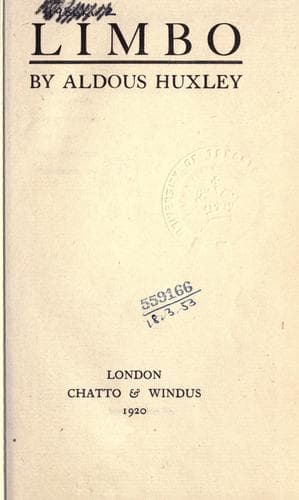
English drama -- 20th century; English fiction -- 20th century; Short stories, English
Probably, Dick reflected as he made his way down the stairs, he
wouldn't see her again for a year or so. He couldn't honestly say that
it affected him much. Other people became daily more and more like
ghosts, unreal, thin, vaporous; while every hour the consciousness of
himself grew more intense and all-absorbing. The only person who was
more than a shadow to him now was Hyman of the _Weekly International_.
In those first horrible months of the war, when he was wrestling with
Pearl Bellairs and failing to cast her out, it was Hyman who kept him
from melancholy and suicide. Hyman made him write a long article every
week, dragged him into the office to do sub-editorial work, kept him
so busy that there were long hours when he had no time to brood over
his own insoluble problems. And his enthusiasm was so passionate and
sincere that sometimes even Dick was infected by it; he could believe
that life was worth living and the cause worth fighting for. But not
for long; for the devil would return, insistent and untiring. Pearl
Bellairs was greedy for life; she was not content with her short
midnight hours; she wanted the freedom of whole days. And whenever
Dick was overtired, or ill or nervous, she leapt upon him and stamped
him out of existence, till enough strength came back for him to
reassert his personality. And the articles she wrote! The short
stories! The recruiting songs! Dick dared not read them; they were
terrible, terrible.
VIII
THE months passed by. The longer the war lasted, the longer it seemed
likely to last. Dick supported life somehow. Then came the menace of
conscription. The _Weekly International_ organized a great
anti-conscription campaign, in which Hyman and Dick were the leading
spirits. Dick was almost happy. This kind of active work was new to
him and he enjoyed it, finding it exciting and at the same time
sedative. For a self-absorbed and brooding mind, pain itself is an
anodyne. He enjoyed his incessant journeys, his speechmaking to queer
audiences in obscure halls and chapels; he liked talking with earnest
members of impossible Christian sects, pacifists who took not the
faintest interest in the welfare of humanity at large, but were wholly
absorbed in the salvation of their own souls and in keeping their
consciences clear from the faintest trace of blood-guiltiness. He
enjoyed the sense of power which came to him, when he roused the
passion of the crowd to enthusiastic assent, or breasted the storm of
antagonism. He enjoyed everything--even getting a bloody nose from a
patriot hired and intoxicated by a great evening paper to break up one
of his meetings. It all seemed tremendously exciting and important at
the time. And yet when, in quiet moments, he came to look back on his
days of activity, they seemed utterly empty and futile. What was left
of them? Nothing, nothing at all. The momentary intoxication had died
away, the stirred ant's-nest had gone back to normal life. Futility of
Public-domain text, read in full here on John Shaqi.
Reviews
Reviews
No reviews yet
Be the first to share your thoughts on this work.
Join the Discussion
Join the discussion
Sign in to leave a comment or review.
Sign InorCreate an account