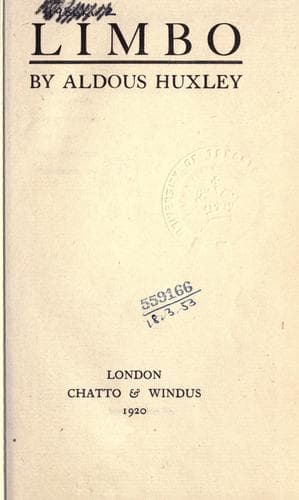
English drama -- 20th century; English fiction -- 20th century; Short stories, English
It was half-way through the summer term, when Dick was sixteen, on one
of those days of brilliant sunshine and cloudless blue, when the sight
of beautiful and ancient buildings is peculiarly poignant. Their age
and quiet stand out in melancholy contrast against the radiant life of
the summer; and at Æsop the boys go laughing under their antique
shadow; "Little victims"--you feel how right Gray was. Dick was idly
strolling across the quadrangle, engaged in merely observing the
beauty about him--the golden-grey chapel, with its deep geometrical
shadows between the buttresses, the comely rose-coloured shapes of the
brick-built Tudor buildings, the weathercocks glittering in the sun,
the wheeling flurries of pigeons. His old discontent had seized on him
again, and to-day in the presence of all this beauty it had become
almost unbearable. All at once, out of the mouth of one of the dark
little tunnelled doors pierced in the flanks of the sleeping building,
a figure emerged into the light. It was Francis Quarles, clad in white
flannels and the radiance of the sunshine. He appeared like a
revelation, bright, beautiful, and sudden, before Dick's eyes. A
violent emotion seized him; his heart leapt, his bowels were moved
within him; he felt a little sick and faint--he had fallen in love.
Francis passed by without deigning to notice him. His head was high,
his eyes drowsy under their drooping lids. He was gone, and for Dick
all the light was out, the beloved quadrangle was a prison-yard, the
pigeons a loathsome flock of carrion eaters. Gay and Partington came
up behind him with shouts of invitation. Dick walked rudely away. God!
how he hated them and their wretched, silly talk and their yellow,
ugly faces.
The weeks that followed were full of strangeness. For the first time
in his life Dick took to writing poetry. There was one sonnet which
began:
Is it a vision or a waking dream?
Or is it truly Apollo that I see,
Come from his sylvan haunts in Arcady
{ laugh and loiter
To {
{ sing and saunter by an English stream. . . .
He kept on repeating the words to himself, "Sylvan haunts in Arcady,"
"laugh and loiter" (after much thought he had adopted that as more
liquidly melodious than "sing and saunter"). How beautiful they
sounded!--as beautiful as Keats--more beautiful, for they were his
own.
Public-domain text, read in full here on John Shaqi.
Reviews
Reviews
No reviews yet
Be the first to share your thoughts on this work.
Join the Discussion
Join the discussion
Sign in to leave a comment or review.
Sign InorCreate an account