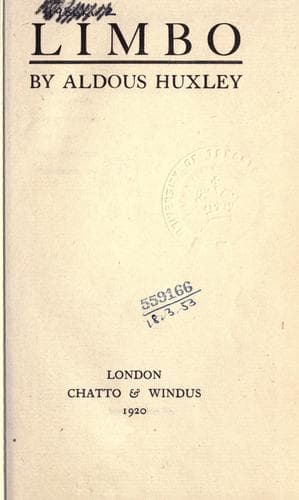
English drama -- 20th century; English fiction -- 20th century; Short stories, English
"Your" classical history, Marjorie repeated to herself, "your"
classical history indeed! Her father had an irritating way of taking
it for granted that she knew everything, that classical history was as
much hers as his. Only a day or two before he had turned to her at
luncheon with, "Do you remember, dear child, whether it was Pomponazzi
who denied the personal immortality of the soul, or else that queer
fellow, Laurentius Valla? It's gone out of my head for the moment."
Marjorie had quite lost her temper at the question--much to the
innocent bewilderment of her poor father.
She had set to work with energy on the Gibbon; her bookmarker
registered the fact that she had got through one hundred and
twenty-three pages yesterday. Marjorie started reading. After two
pages she stopped. She looked at the number of pages still remaining
to be read--and this was only the first volume. She felt like a wasp
sitting down to eat a vegetable marrow. Gibbon's bulk was not
perceptibly diminished by her first bite. It was too long. She shut
the book and went out for a walk. Passing the Whites' house, she saw
her friend, Beatrice White that was, sitting on the lawn with her two
babies. Beatrice hailed her, and she turned in.
"Pat a cake, pat a cake," she said. At the age of ten months, baby
John had already learnt the art of patting cakes. He slapped the
outstretched hand offered him, and his face, round and smooth and pink
like an enormous peach, beamed with pleasure.
"Isn't he a darling!" Marjorie exclaimed. "You know, I'm sure he's
grown since last I saw him, which was on Tuesday."
"He put on eleven ounces last week," Beatrice affirmed.
"How wonderful! His hair's coming on splendidly . . ."
* * * * *
It was Sunday the next day. Jacobsen appeared at breakfast in the
neatest of black suits. He looked, Marjorie thought, more than ever
like a cashier. She longed to tell him to hurry up or he'd miss the
8.53 for the second time this week and the manager would be annoyed.
Marjorie herself was, rather consciously, not in Sunday best.
"What is the name of the Vicar?" Jacobsen inquired, as he helped
himself to bacon.
"Trubshaw. Luke Trubshaw, I believe."
"Does he preach well?"
"He didn't when I used to hear him. But I don't often go to church
now, so I don't know what he's like these days."
"Why don't you go to church?" Jacobsen inquired, with a silkiness of
tone which veiled the crude outlines of his leading question.
Marjorie was painfully conscious of blushing. She was filled with rage
against Jacobsen. "Because," she said firmly, "I don't think it
necessary to give expression to my religious feelings by making a lot
of"--she hesitated a moment--"a lot of meaningless gestures with a
crowd of other people."
"You used to go," said Jacobsen.
"When I was a child and hadn't thought about these things."
Public-domain text, read in full here on John Shaqi.
Reviews
Reviews
No reviews yet
Be the first to share your thoughts on this work.
Join the Discussion
Join the discussion
Sign in to leave a comment or review.
Sign InorCreate an account