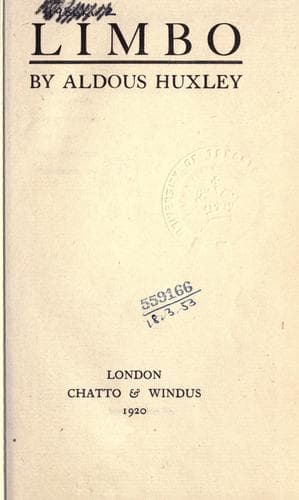
English drama -- 20th century; English fiction -- 20th century; Short stories, English
Jacobsen was silent, and concealed a smile in his coffee-cup. Really,
he said to himself, there ought to be religious conscription for
women--and for most men, too. It was grotesque the way these people
thought they could stand by themselves--the fools, when there was the
infinite authority of organized religion to support their ridiculous
feebleness.
"Does Lambourne go to church?" he asked maliciously, and with an air
of perfect naïveté and good faith.
Marjorie coloured again, and a fresh wave of hatred surged up within
her. Even as she had said the words she had wondered whether Jacobsen
would notice that the phrase "meaningless gestures" didn't ring very
much like one of her own coinages. "Gesture"--that was one of Guy's
words, like "incredible," "exacerbate," "impinge," "sinister." Of
course all her present views about religion had come from Guy. She
looked Jacobsen straight in the face and replied:
"Yes, I think he goes to church pretty regularly. But I really don't
know: his religion has nothing to do with me."
Jacobsen was lost in delight and admiration.
Punctually at twenty minutes to eleven he set out for church. From
where she was sitting in the summer-house Marjorie watched him as he
crossed the garden, incredibly absurd and incongruous in his black
clothes among the blazing flowers and the young emerald of the trees.
Now he was hidden behind the sweet-briar hedge, all except the hard
black melon of his bowler hat, which she could see bobbing along
between the topmost sprays.
She went on with her letter to Guy. ". . . What a strange man Mr.
Jacobsen is. I suppose he is very clever, but I can't get very much
out of him. We had an argument about religion at breakfast this
morning; I rather scored off him. He has now gone off to church all by
himself;--I really couldn't face the prospect of going with him--I
hope he'll enjoy old Mr. Trubshaw's preaching!"
Jacobsen did enjoy Mr. Trubshaw's preaching enormously. He always made
a point, in whatever part of Christendom he happened to be, of
attending divine service. He had the greatest admiration of churches
as institutions. In their solidity and unchangeableness he saw one of
the few hopes for humanity. Further, he derived great pleasure from
comparing the Church as an institution--splendid, powerful,
eternal--with the childish imbecility of its representatives. How
delightful it was to sit in the herded congregation and listen to the
sincere outpourings of an intellect only a little less limited than
that of an Australian aboriginal! How restful to feel oneself a member
of a flock, guided by a good shepherd--himself a sheep! Then there was
the scientific interest (he went to church as student of anthropology,
as a Freudian psychologist) and the philosophic amusement of counting
the undistributed middles and tabulating historically the exploded
fallacies in the parson's discourse.
Public-domain text, read in full here on John Shaqi.
Reviews
Reviews
No reviews yet
Be the first to share your thoughts on this work.
Join the Discussion
Join the discussion
Sign in to leave a comment or review.
Sign InorCreate an account