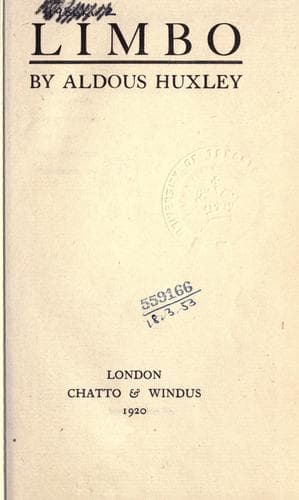
English drama -- 20th century; English fiction -- 20th century; Short stories, English
"The Græco-Roman and the Gothic side by side!" she exclaimed. "Lord
Francis is something in the Vatican, a rather late piece of work; and
Mr. Greenow is a little gargoyle from the roof of Notre Dame de Paris.
Two epochs of art--how clearly one sees the difference. And my
husband, I always think, is purely Malayan in design--purely Malayan,"
she repeated as she shook hands with the two boys.
Dick blushed to the roots of his hair, but Francis' impassive
arrogance remained unmoved. Dick stole a glance in his direction, and
at the sight of his calm face he felt a new wave of adoring admiration
sweeping through him.
The company was assembled and complete, Mrs. Cravister looked round
the room and remarking, "We won't wait for Mr. Copthorne-Slazenger,"
sailed majestically in the direction of the door. She particularly
disliked this member of her husband's staff, and lost no opportunity
of being rude to him. Thus, where an ordinary hostess might have said,
"Shall we come in to dinner?" Mrs. Cravister employed the formula, "We
won't wait for Mr. Copthorne-Slazenger"; and a guest unacquainted with
Mrs. Cravister's habits would be surprised on entering the dining-room
to find that all the seats at the table were filled, and that the meal
proceeded smoothly without a single further reference to the missing
Copthorne, who never turned up at all, for the good reason that he had
never been invited.
Dinner began a little nervously and uncomfortably. At one end of the
table the Headmaster was telling anecdotes of Æsop in the sixties, at
which the boys in his neighbourhood laughed with a violent nervous
insincerity. Henry Cravister, still talking about eschatology, was
quoting from Sidonius Apollinarius and Commodianus of Gaza. Mrs.
Cravister, who had been engaged in a long colloquy with the butler,
suddenly turned on Dick with the remark, "And so you have a deep,
passionate fondness for cats," as though they had been intimately
discussing the subject for the last hour. Dick had enough presence of
mind to say that, yes, he did like cats--all except those Manx ones
that had no tails.
"No tails," Mrs. Cravister repeated--"no tails. Like men. How
symbolical everything is!"
Francis Quarles was sitting opposite him, so that Dick had ample
opportunity to look at his idol. How perfectly he did everything, down
to eating his soup! The first lines of a new poem began to buzz in
Dick's head:
"All, all I lay at thy proud marble feet--
My heart, my love and all my future days.
Upon thy brow for ever let me gaze,
For ever touch thy hair: oh (something) sweet . . ."
Would he be able to find enough rhymes to make it into a sonnet? Mrs.
Cravister, who had been leaning back in her chair for the last few
minutes in a state of exhausted abstraction, opened her eyes and said
to nobody in particular:
"Ah, how I envy the calm of those Chinese dynasties!"
"Which Chinese dynasties?" a well-meaning youth inquired.
Public-domain text, read in full here on John Shaqi.
Reviews
Reviews
No reviews yet
Be the first to share your thoughts on this work.
Join the Discussion
Join the discussion
Sign in to leave a comment or review.
Sign InorCreate an account