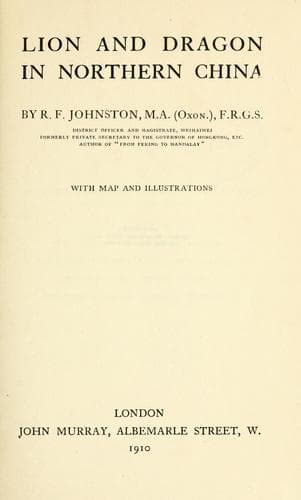
Lion and Dragon in Northern ChinaJohnston, Reginald Fleming, Sir
History
Lion and Dragon in Northern China
Johnston, Reginald Fleming, Sir
Weihai (China) -- History; Weihai (China) -- Social life and customs
But there are other forces at work besides those that may come from
foreign commercial or industrial enterprise, whereby Weihaiwei may
become a far less desirable school than it is at present for the
student of the Chinese social organism. Hitherto Weihaiwei has with
considerable success protected itself behind walls of conservatism
and obedience to tradition against the onslaughts of what a Confucian
archbishop, if such a dignitary existed, might denounce as "Modernism."
But those walls, however substantial they may appear to the casual
eye, are beginning to show signs of decay. There is indeed no part of
China, or perhaps it would be truer to say no section of the Chinese
people, that is totally unaffected at the present day by the modern
spirit of change and reform. It is naturally the most highly educated
of the people who are the most quickly influenced and roused to action,
and the people of Weihaiwei, as it happens, are, with comparatively
few exceptions, almost illiterate. But the spirit of change is "in
the air," and reveals itself in cottage-homes as well as in books and
newspapers and the marketplaces of great cities. Let us hope, for the
good of China, that the stout walls of conservatism both in Weihaiwei
and elsewhere will not be battered down too soon or too suddenly.
One of the gravest dangers overhanging China at the present day is
the threatened triumph of mere theory over the results of accumulated
experience. Multitudes of the ardent young reformers of to-day--not
unlike some of the early dreamers of the French Revolution--are
aiming at the destruction of all the doctrines that have guided the
political and social life of their country for three thousand years,
and hope to build up a strong and progressive China on a foundation of
abstract principles. With the hot-headed enthusiasm of youth they speak
lightly of the impending overthrow, not only of the decaying forces of
Buddhism and Taoism, but also of the great politico-social structure of
Confucianism, heedless of the possibility that these may drag with them
to destruction all that is good and sound in Chinese life and thought.
Buddhism (in its present Chinese form) might, indeed, be extinguished
without much loss to the people; Taoism (such as it is nowadays) might
vanish absolutely and for ever, leaving perhaps no greater sense of
loss than was left by the decay of a belief in witchcraft and alchemy
among ourselves; but Confucianism (or rather the principles and
doctrines which Confucianism connotes, for the system dates from an
age long anterior to that of Confucius) cannot be annihilated without
perhaps irreparable injury to the body-social and body-politic of
China. The collapse of Confucianism would undoubtedly involve, for
example, the partial or total ruin of the Chinese family system and the
cult of ancestors.
Public-domain text, read in full here on John Shaqi.
Reviews
Reviews
No reviews yet
Be the first to share your thoughts on this work.
Join the Discussion
Join the discussion
Sign in to leave a comment or review.
Sign InorCreate an account