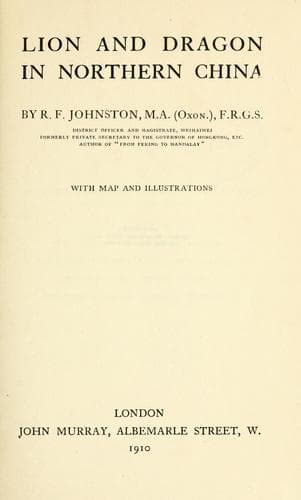
Lion and Dragon in Northern ChinaJohnston, Reginald Fleming, Sir
History
Lion and Dragon in Northern China
Johnston, Reginald Fleming, Sir
Weihai (China) -- History; Weihai (China) -- Social life and customs
With the exception of Roman Catholics and the older generation of
Protestant missionaries with a good many of their successors, who
condemn all Chinese religion as false or "idolatrous," few, if any,
European students of China will be heard to disapprove--whether on
ethical or religious grounds--of that keystone of the Chinese social
edifice known to Europeans as ancestor-worship. To the revolutionary
doctrines of the extreme reformers Weihaiwei and other "backward"
and conservative parts of China are--half unconsciously--opposing a
salutary bulwark. They cannot hope to keep change and reform altogether
at a distance, nor is it at all desirable that they should do so;
indeed, as we have seen, their walls of conservatism are already
beginning to crumble. But if they only succeed in keeping the old
flag flying until the attacking party has been sobered down by time
and experience and has become less anxious to sweep away all the
time-honoured bases of morality and social government, these old
centres of conservatism will have deserved the gratitude of their
country. What indeed could be more fitting than that the Confucian
system should find its strongest support, and perhaps make its last
fight for life, in the very province in which the national sage
lived and taught, and where his body has lain buried for twenty-five
centuries?
FOOTNOTES:
[1] See pp. 230 _seq._, 233 _seq._
[2] _The Religious System of China_, vol. ii. p. 806.
[3] See pp. 281 _seq._
[4] _Op. cit._ vol. iii. p. 854.
CHAPTER II
WEIHAIWEI AND THE SHANTUNG PROMONTORY
As applied to the territory leased by China to Great Britain the word
Weihaiwei is in certain respects a misnomer. The European reader
should understand that the name is composed of three separate Chinese
characters, each of which has a meaning of its own.[5] The first of
the three characters (transliterated _Wei_ in Roman letters) is not
the same as the third: the pronunciation is the same but the "tone"
is different, and the Chinese symbols for the two words are quite
distinct. The first _Wei_ is a word meaning Terrible, Majestic,
or Imposing, according to its context or combinations. The word
_hai_ means the Sea. The combined words Weihai Ch'êng or Weihai
City, which is the real name of the little town that stands on the
mainland opposite the island of Liukung, might be roughly explained
as meaning "City of the August Ocean," but in the case of Chinese
place-names, as of personal names, translations are always unnecessary
and often meaningless. The third character, _Wei_, signifies a Guard
or Protection; but in a technical sense, as applied to the names of
places, it denotes a certain kind of garrisoned and fortified post
partially exempted from civil jurisdiction and established for the
protection of the coast from piratical raids, or for guarding the
highways along which tribute-grain and public funds are carried through
the provinces to the capital.
Public-domain text, read in full here on John Shaqi.
Reviews
Reviews
No reviews yet
Be the first to share your thoughts on this work.
Join the Discussion
Join the discussion
Sign in to leave a comment or review.
Sign InorCreate an account