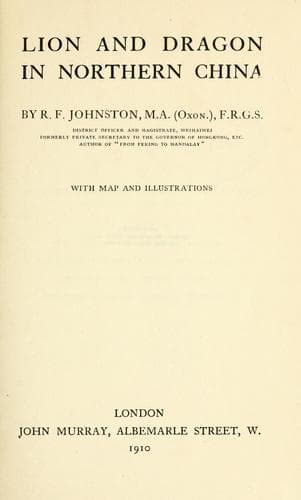
Lion and Dragon in Northern ChinaJohnston, Reginald Fleming, Sir
History
Lion and Dragon in Northern China
Johnston, Reginald Fleming, Sir
Weihai (China) -- History; Weihai (China) -- Social life and customs
"This _ch'u tan_ is executed by Yü T'sung Shih. Inasmuch as her
three sons have set up separate establishments, and one of them,
namely her second son Shu-yen, has been adopted by another branch
of the family, Yü Ts'ung Shih, with the knowledge and assent of
the elders and relatives of the family, reserves to her own use
that house situated ... and that piece of land measuring ..., for
the purpose of providing for her support during life and for her
burial expenses after death.[94] All that remains of this property
after these charges have been met is to be equally divided between
the first and third sons T'sung Shu-tung and Ts'ung Shu-shan. The
second son, Ts'ung Shu-yen, has no share in or right to any portion
of this property, as he cannot carry the family property away with
him when he is 'adopted out.'[95] Lest there should be no proof of
this transaction hereafter, this deed is drawn up and attested, and
is to be preserved for future reference."
It will be seen from the first of these two documents that a method of
dividing real property among brothers is the drawing of lots (_nien
chu_ or _chiu fên_). There is no system of primogeniture: all the
brothers receive share and share alike. The process of lot-drawing
is a very simple one. The family-in-council begins by dividing the
property into a number of shares corresponding with the number of the
beneficiaries. The shares are approximately equal in value: one may
include the family dwelling-house and a small area of arable land;
another share, containing no house, will comprise a larger area of
land; and so forth. Descriptions of all the shares are written on
separate pieces of paper, which are folded up or twisted into little
bundles and thrown together in a heap. The second, third and fourth
brothers, and so on down to the youngest, draw lots, each in the
order of seniority; the sole remaining lot is thus left to the eldest
brother. Each must be content with the piece of land, or the house, or
the vegetable garden, as the case may be, which is inscribed on his
lot, though friendly exchanges are of course permissible. The eldest
brother is so far from having a claim to a larger or better share than
the rest that, as we see, he is not even entitled to draw the first
lot: probably, indeed, it is to emphasise the principle of share and
share alike that custom requires him to take the lot that is left to
the last. The drawing of lots is not resorted to in cases where the
shares are all equal and there are no preferences.
Public-domain text, read in full here on John Shaqi.
Reviews
Reviews
No reviews yet
Be the first to share your thoughts on this work.
Elsewhere in the archive
Join the Discussion
Join the discussion
Sign in to leave a comment or review.
Sign InorCreate an account