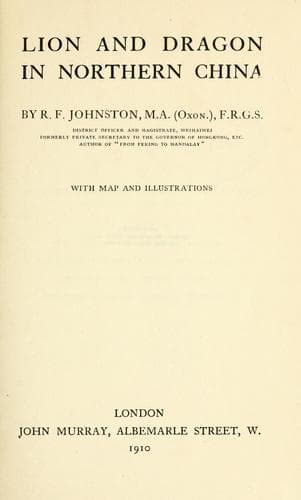
Lion and Dragon in Northern ChinaJohnston, Reginald Fleming, Sir
History
Lion and Dragon in Northern China
Johnston, Reginald Fleming, Sir
Weihai (China) -- History; Weihai (China) -- Social life and customs
Very frequently a _ma-chieh-ti_ who brings her imagined wrongs to court
will point to wounds and scratches on her face and body as evidence
that she has been assaulted: whereas the injuries have been in all
probability self-inflicted. One Liang Wang Shih brought complaints of
ill-treatment against her adopted grandson and his wife. "They behave
in a most cruel manner," she said. "He incites her to bite me. She
bites my shoulder." She then proceeded partially to disrobe herself
in order that the supposed marks of her grand-daughter's teeth might
be inspected by the court. Another querulous woman forcibly prevented
a neighbour from putting a wall round his own vegetable-garden. "I
recently built a new house," explained her unfortunate neighbour. "This
woman's grandson died soon afterwards, and she declares that it was my
new house that killed him, by spoiling the _fêng-shui_ of her family.
She says she will not let me build my garden-wall until I restore her
grandson to life."
The marriage customs of Weihaiwei being in principle identical with
those prevailing in other parts of China, a detailed description
of them would be out of place here. It will be sufficient to say
that nearly every one gets married a few years after arrival at a
marriageable age, the bridegroom being as a rule rather older than
the bride. The majority of marriages are the outcome of long-standing
betrothals. A betrothal is in practice as binding as a marriage;
indeed, a betrothal that took place in the babyhood of both the
principals may, in certain circumstances, be regarded as an actual
marriage. If, for example, the youth dies when of marriageable age
but before the marriage has taken place, and if he was at the same
time an only son, the betrothed girl (whom he may or may not have
seen) will often be recognised as his legal wife; and if she preserves
her "widowhood" with fidelity her name will appear beside his own on
the tombstone and in the family registers. If the girl declares at
the death of her betrothed that she is willing to be regarded as his
widow, it then becomes possible (in accordance with an old and very
curious custom) for the dead youth and his living wife to be provided
with a "son" by adoption, and this "son"--who will probably be a young
nephew--nominally acts as principal mourner at the funeral, inherits
the deceased's share of the family property, and carries on the rites
of ancestral worship. If the girl or her family decline (as very
naturally they usually do) to recognise the betrothal contract as
binding after the bridegroom's death, the parents of the dead youth
will proceed to find him a bride in the person of a dead girl. This
girl must have died unmarried and should be of suitable age and family:
that is to say, a youth and maiden who could not have been betrothed to
each other in life should not be joined in matrimony after death.[164]
Public-domain text, read in full here on John Shaqi.
Reviews
Reviews
No reviews yet
Be the first to share your thoughts on this work.
Elsewhere in the archive
Join the Discussion
Join the discussion
Sign in to leave a comment or review.
Sign InorCreate an account