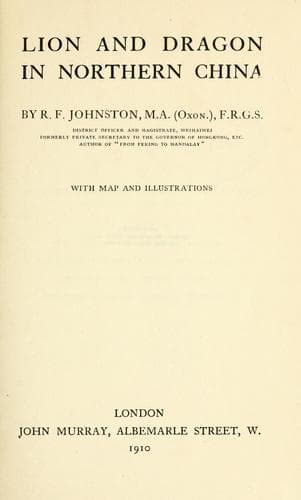
Lion and Dragon in Northern ChinaJohnston, Reginald Fleming, Sir
History
Lion and Dragon in Northern China
Johnston, Reginald Fleming, Sir
Weihai (China) -- History; Weihai (China) -- Social life and customs
The arrangements for a wedding of this extraordinary nature are not
carried out directly by the parents of the dead boy and girl, but
through middlemen appointed by them (known as _kuei mei_ or "ghostly
go-betweens"), and many of the other formalities which attend an
ordinary marriage are observed with scrupulous care. If the girl has
already been buried in the graveyard of her own family her body is
exhumed and reburied beside that of the dead bridegroom: and on the
tombstone erected at the foot of the grave are duly carved their two
names as those of husband and wife. The custom is extremely old: it
is mentioned in the _Chou Li_, a book which deals with the laws and
customs of China from the twelfth century B.C. onwards. Its origin
may perhaps be traced to the same notions that lay at the root of
the widely-prevalent Oriental custom of widow immolation or _sati_:
the theory being that the sacrifice of widows and slaves at the tomb
of a dead man provided him in the comfortless world of shades with
the companionship to which he had been accustomed in life. But this
strange system of weddings between the dead is practised to-day in
Weihaiwei only in order to secure the perpetuation of the sacrificial
rites connected with the ancestral cult and to bring about a suitable
partition of the family property.
If a youth dies unmarried and is an only son, the necessary consequence
would appear to be the extinction of the family or the particular
branch which the deceased represented. To prevent the occurrence of
such a calamity it is necessary in China to provide the deceased with
a son by formal adoption. But the matter-of-fact Chinese mind declines
to contemplate the possibility of adopting a son for one who, being
a bachelor, was not in a position to have a legitimate heir in the
ordinary process of nature. It is therefore necessary to begin by
providing him with a wife; and this is done by the peculiar arrangement
just described, known locally as _ka_ (or _chieh_) _ssŭ ch'in_--the
"celebration of a dead marriage." As a rule it is not difficult for
parents to find a suitable wife for their dead son, for the family
of a girl who has died unmarried will always be glad to have their
deceased daughter raised to the honourable status of a married woman.
Sometimes, however, complicating circumstances arise. A man named Yü
Huai-yüeh died, without children and unmarried, in the tenth year of
Kuang Hsü--corresponding to 1884. At that time he had brothers living,
and as the family was in no danger of extinction it was not considered
necessary to take further action. During subsequent years the brothers
also died without issue, and the sorrowing relatives of the family
decided in 1897 that Yü Huai-yüeh should at last be provided with a
wife. In due time it was reported by "ghostly go-betweens" that a bride
with a suitable horoscope was to be found in the family of Hsia of the
neighbouring village of Chao Chia. This was a girl who had died as
long ago as 1876.
Public-domain text, read in full here on John Shaqi.
Reviews
Reviews
No reviews yet
Be the first to share your thoughts on this work.
Elsewhere in the archive
Join the Discussion
Join the discussion
Sign in to leave a comment or review.
Sign InorCreate an account