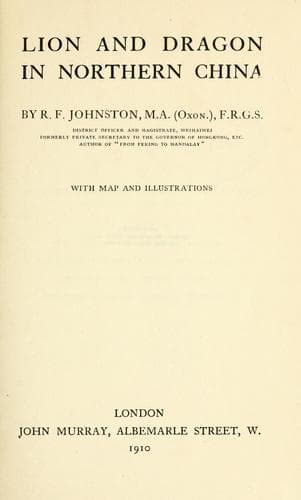
Lion and Dragon in Northern ChinaJohnston, Reginald Fleming, Sir
History
Lion and Dragon in Northern China
Johnston, Reginald Fleming, Sir
Weihai (China) -- History; Weihai (China) -- Social life and customs
It must have been the treelessness of the district and the waterless
condition of the mountains as viewed from the harbour and the sea-coast
that prompted the remark made in an official report some years ago
that Weihaiwei is "a colder Aden"; and indeed if we contemplate the
coast-line from the deck of a steamer the description seems apt enough.
A ramble through the Territory among the valleys and glens that
penetrate the interior in every direction is bound to modify one's
first cheerless impressions very considerably. Trees, it is true, are
abundant only in the immediate neighbourhood of villages and in the
numerous family burial-grounds; but the streams are often lined with
graceful willows, and large areas on the mountain-slopes are covered
with green vegetation in the shape of scrub-oak. At certain seasons of
the year the want of trees is from an æsthetic point of view partly
atoned for by the blended tints of the growing crops; and certainly
to the average English eye the waving wheat-fields and the harvesters
moving sickle in hand through the yellow grain offer a fairer and more
home-like spectacle than is afforded by the marshy rice-lands of the
southern provinces. On the whole, indeed, the scenery of Weihaiwei is
picturesque and in some places beautiful.[10] The chief drawback next
to lack of forest is the want of running water. The streams are only
brooks that can be crossed by stepping-stones. In July and August, when
the rainfall is greatest, they become enormously swollen for a few
days, but their courses are short and the flood-waters are soon carried
down to the sea. In winter and spring some of the streams wholly
disappear, and the greatest of them becomes the merest rivulet.
The traveller who approaches Weihaiwei by sea from the east or south
makes his first acquaintance with the Shantung coast at a point
about thirty miles (by sea) east of the Weihaiwei harbour. This is
the Shantung Promontory, the Chinese name of which is Ch'êng Shan
Tsui or Ch'êng Shan T'ou. Ch'êng Shan is the name of the hill which
forms the Promontory, while _Tsui_ and _T'ou_ (literally Mouth and
Head) mean Cape or Headland. Before the Jung-ch'êng magistracy was
founded (in 1735) this extreme eastern region was a military district
like Weihaiwei. Taking its name from the Promontory, it was known as
Ch'êng-shan-wei.
[Illustration: THE MANG-TAO TREE (see p. 384).]
[Illustration: A HALT IN YÜ-CHIA-K'UANG DEFILE (see p. 18).]
Ch'êng Shan, with all the rest of the present Jun-ch'êng district, is
within the British "sphere of influence"; that is to say, Great Britain
has the right to erect fortifications there and to station troops:
rights which, it may be mentioned, have never been exercised.
Public-domain text, read in full here on John Shaqi.
Reviews
Reviews
No reviews yet
Be the first to share your thoughts on this work.
Join the Discussion
Join the discussion
Sign in to leave a comment or review.
Sign InorCreate an account