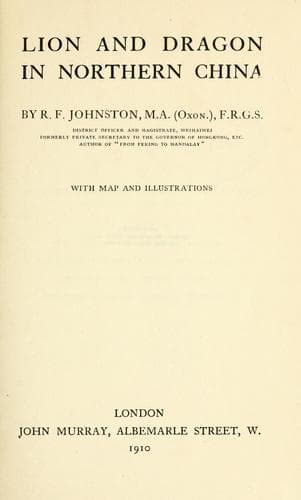
Lion and Dragon in Northern ChinaJohnston, Reginald Fleming, Sir
History
Lion and Dragon in Northern China
Johnston, Reginald Fleming, Sir
Weihai (China) -- History; Weihai (China) -- Social life and customs
The Shantung Promontory has been the scene of innumerable shipwrecks,
for the sea there is apt to be rough, fogs are not uncommon, and
there are many dangerous rocks. The first lighthouse--a primitive
affair--is said to have been erected in 1821 by a pious person named
Hsü Fu-ch'ang; but long before that a guild of merchants used to light
a great beacon fire every night on a conspicuous part of the hill.
A large bell was struck, so the records state, when the weather was
foggy. The present lighthouse is a modern structure under the charge of
the Chinese Imperial Customs authorities. Behind the Promontory--that
is, to the west (landward) side--there is a wide stretch of
comparatively flat land which extends across the peninsula. It may be
worth noting that an official of the Ming dynasty named T'ien Shih-lung
actually recommended in a state paper that a canal should be cut
through this neck of land so as to enable junks to escape the perils of
the rock-bound Promontory. He pointed out that the land was level and
sandy and that several ponds already existed which could be utilised
in the construction of the canal. Thus, he said, could be avoided the
great dangers of the rocks known as Shih Huang Ch'iao and Wo Lung Shih.
The advice of the amateur engineer was not acted upon, but his memorial
(perhaps on account of its literary style) was carefully preserved and
has been printed in the Chinese annals of the Jung-ch'êng district.
These annals contain an interesting reference to one of the two groups
of rocks just named. Wo Lung Shih means "Sleeping dragon rocks," and
no particular legend appears to be attached to them, though it would
have been easy to invent one. But the Shih Huang Ch'iao, or Bridge of
the First Emperor, is regarded by the people as a permanent memorial
of that distinguished monarch who in the third century B.C. seized the
tottering throne of the classic Chou dynasty and established himself as
the First Emperor (for such is the title he gave himself) of a united
China. Most Europeans know nothing of this remarkable man except that
he built the Great Wall of China and rendered his reign infamous by the
Burning of the Books and the slaughter of the scholars. Whether his
main object in the latter proceeding was to stamp out all memory of the
acts of former dynasties so that to succeeding ages he might indeed be
the First of the historical Emperors, or whether it was not rather an
act of savagery such as might have been expected of one who was not
"born in the purple" and who derived his notions of civilisation from
the semi-barbarous far-western state of Ch'in, is perhaps an impossible
question to decide: and indeed the hatred of the Chinese _literati_ for
a sovereign who despised literature and art may possibly have led them
to be guilty of some exaggeration in the accounts they have given us of
his acts of vandalism and murder.
Public-domain text, read in full here on John Shaqi.
Reviews
Reviews
No reviews yet
Be the first to share your thoughts on this work.
Join the Discussion
Join the discussion
Sign in to leave a comment or review.
Sign InorCreate an account