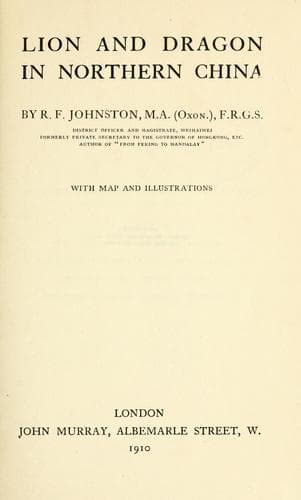
Lion and Dragon in Northern ChinaJohnston, Reginald Fleming, Sir
History
Lion and Dragon in Northern China
Johnston, Reginald Fleming, Sir
Weihai (China) -- History; Weihai (China) -- Social life and customs
Chinese local histories contain many accounts of the various devices
resorted to by devoted widows for the purpose of avoiding the
dishonour of a second marriage. De Groot[171] quotes the case of a
child-widow--she was only fifteen years of age--who, as a reply to the
demands made upon her to enter into a second marriage, took a solemn
oath of chastity and confirmed it by cutting off her ears and placing
them on a dish. Thereupon, as the historian says, her relatives "gave
up their project," perhaps from pity or admiration of the poor child's
heroic conduct, perhaps from the belief that no self-respecting man
would care for an earless bride. If the annals of Weihaiwei show no
cases quite identical with this, they contain accounts of many a young
widow who has died to avoid remarriage.
But first let us consider a few typical cases of a less tragic nature.
Of Wang Shih, the wife of a graduate named Ch'i, we are told that when
her husband died leaving her with an infant boy, she, though still a
very young woman, refrained from a second marriage, lived an exemplary
life, educated her boy with exceptional care, and survived to the age
of ninety-five: living just long enough to witness the marriage of her
great-grandson. To live to a green old age is regarded as one of the
rewards of a virtuous life. In China, those whom the gods love die old.
Ch'ê Liu Shih, say the Annals of Ning-hai, was for similar reasons
rewarded by no less than one hundred and two years of life. This was
in the present dynasty. Judging by length of life, still higher virtue
must have been shown in the Yüan dynasty (1280-1367), for we read of
Liu Shih, a lady who lived to the age of one hundred and three, and was
celebrated as the happy mother of three noble sons. T'ang Chu Shih, a
Ning-hai widow of the Ming dynasty, became so famous for her virtuous
refusals of marriage that she was honoured by the local magistrate with
the official presentation of a laudatory scroll bearing the words "Pure
and chaste as frozen snow." Wang Sun Shih became a grass-widow about
ten days after her marriage, for her husband was obliged to go abroad.
After a short absence news was brought her that her lord was dead. She
was wretchedly poor, but she maintained an honourable widowhood to
her death. Yüeh Ch'i Shih was left a widow soon after marriage. The
family was very poor. She served her father-in-law and brought up her
son with the utmost zeal and care. She was most industrious (all this
is carefully recorded in the Annals) in looking after the household
and in preparing the morning and evening meals. She worked all her ten
fingers to the utmost without sparing herself. She died when still
young. Sun Liu Shih became a widow at the age of nineteen. She strongly
desired to die with her husband, but her parents-in-law pointed out
that they were old and required her services. She obeyed and remained
with them, refusing remarriage. She arranged to have a son adopted for
Public-domain text, read in full here on John Shaqi.
Reviews
Reviews
No reviews yet
Be the first to share your thoughts on this work.
Elsewhere in the archive
Join the Discussion
Join the discussion
Sign in to leave a comment or review.
Sign InorCreate an account