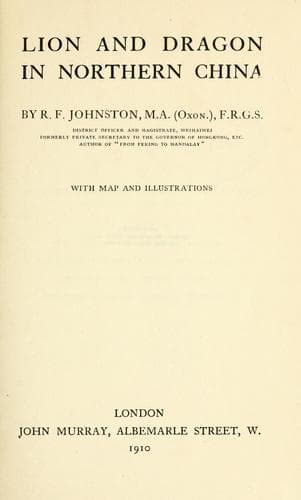
Lion and Dragon in Northern ChinaJohnston, Reginald Fleming, Sir
History
Lion and Dragon in Northern China
Johnston, Reginald Fleming, Sir
Weihai (China) -- History; Weihai (China) -- Social life and customs
Even distance does not seem to lend much enchantment to the Chinese
child from the European point of view. He is commonly caricatured
somewhat after this fashion: he never smiles; he has hardly any nose
and possesses oblique eyes that are almost invisible; he wears too many
clothes in winter, so that he looks like an animated plum-pudding; he
wears too little in summer--his birthday dress, to be explicit--and
looks like a jointed wooden doll; he has a horror of "romping"; he is
unwashed, deceitful and cruel; he cultivates a solemnity of demeanour
with the view of leading people to think he is precociously wise and
preternaturally good; and he is always mouthing philosophic saws
from Confucius which he has learned by rote and of which he neither
knows nor wants to know the meaning. Of course there is much in this
description that is totally false and misleading, but it is not
difficult to see the superficial characteristics that may give such a
caricature a certain amount of plausibility.
To form a true idea of what Chinese children really are we must take
them unawares among their own people, if we are fortunate enough to
have opportunities of doing so. We must go into the country fields
and villages and see them at work and play; we must watch them at
their daily round of duties and pleasures, at school (one of the
old-fashioned schools if possible), in times of sickness and pain,
on occasions of festivals, family gatherings, weddings and funerals.
The more we see of them in their own houses and surrounded by their
own relatives the better we shall understand them and the more we
shall like them. They are highly intelligent, quick to see the merry
side of things, brimful of healthy animal spirits, and exceedingly
companionable. This applies not only to the boys but also in a smaller
degree to the girls, who, however, are much less talkative than they
come to be in later years and are apt to be more timid and shy than
their little brothers. They are terribly handicapped by the cruel
custom of foot-binding, which it is earnestly to be hoped will before
long be utterly abolished throughout China. It has undoubtedly caused
a far greater aggregate amount of pain and misery in China than has
been produced by opium-smoking. In spite of the cruelty involved in
foot-binding, the rather common impression that the Chinese have no
affection for their daughters or regard the birth of a girl as a
domestic calamity is very far from correct. That a son is welcomed
with greater joy than a daughter is true, but that a daughter is not
welcomed at all is a view which is daily contradicted by experience.
Mothers, especially, are often as devoted to their girls as they are
to their boys. In the autumn of 1909 a headman reported to me that a
woman of his village had killed herself because she was distracted with
grief on account of the death of her child. The child in question was
a girl, fourteen years of age. "Her mother," said the headman, "begged
Public-domain text, read in full here on John Shaqi.
Reviews
Reviews
No reviews yet
Be the first to share your thoughts on this work.
Elsewhere in the archive
Join the Discussion
Join the discussion
Sign in to leave a comment or review.
Sign InorCreate an account