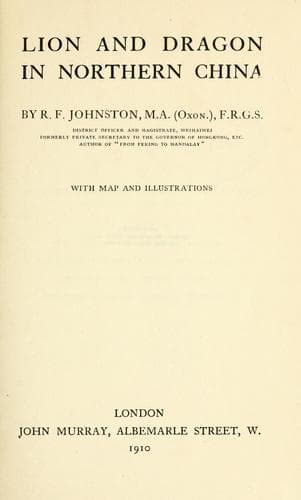
Lion and Dragon in Northern ChinaJohnston, Reginald Fleming, Sir
History
Lion and Dragon in Northern China
Johnston, Reginald Fleming, Sir
Weihai (China) -- History; Weihai (China) -- Social life and customs
Heaven (_Lao T'ien-yeh_) to bring her daughter back to life, and she
declared that she would willingly give her life in exchange for that of
her daughter." It is erroneous to suppose that the old loving relations
between mother and daughter are necessarily severed on the daughter's
marriage. It is often the case that a young married woman's greatest
happiness consists in periodical visits to her old home.
On the whole it may be said that Chinese children are neither better
nor worse, neither more nor less delightful, than the children of
the West, and that child-nature is much the same all the world over.
Among their most conspicuous qualities are their good-humour and
patience. Chinese children bear illness and pain like little heroes.
This need not be ascribed entirely to the oft-asserted cause that
"Chinese have no nerves," though indeed there is good reason to believe
that the people of the West (perhaps owing to the relaxing effects
of a pampering civilisation) are considerably more sensitive to
physical suffering than the people of the Orient. Another interesting
characteristic of Chinese children consists in the fact that good
manners very often appear, at first sight, to be innate rather than
acquired. Even illiterate children, and the children of illiterate
parents, seem to behave with a politeness and grace of manner towards
their elders and superiors (more particularly, of course, those of
their own race) which they certainly have not learned by direct
teaching. A well-bred European child sometimes gives one the impression
that he has learned his exemplary "manners" as a lesson, just as he
learns the tributaries of the Ouse or the dates of the kings. The most
remarkable point about the Chinese child's "manners" is the grace and
ease with which he displays them and the entire absence of _mauvaise
honte_. No doubt the truth of the matter is that courtesy is no more
a natural quality in the Chinese than in other races. The average
peasant's child in north China, who is always treated with what seems
to us excessive indulgence--being allowed to run wild and hardly ever
punished for his childish acts of "naughtiness" and disobedience--grows
up a devoted and obedient son and most courteous and conciliatory, as a
rule, in his dealings with the outside world; but these graces were not
born in him except possibly in the merely potential form of hereditary
predisposition. He has acquired them unconsciously through the medium
of that "endless imitation" which, as Wordsworth said, seems at times
to be the "whole vocation" of a healthy child. Doubtless he learns the
forms of politeness to some extent from his schoolmaster--and indeed
if ethical teaching can make a good boy, then the educated Chinese boy
should be perfect; but that school teaching is not everything is proved
by the fact that in a poor country-district like Weihaiwei, where only
a small proportion of the children go to school, there is no essential
Public-domain text, read in full here on John Shaqi.
Reviews
Reviews
No reviews yet
Be the first to share your thoughts on this work.
Elsewhere in the archive
Join the Discussion
Join the discussion
Sign in to leave a comment or review.
Sign InorCreate an account