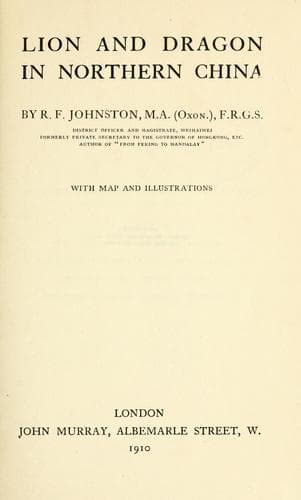
Lion and Dragon in Northern ChinaJohnston, Reginald Fleming, Sir
History
Lion and Dragon in Northern China
Johnston, Reginald Fleming, Sir
Weihai (China) -- History; Weihai (China) -- Social life and customs
[200] In ancient Egypt the cemeteries were overshadowed by thick
sycamores; and probably in nearly every country the planting of trees
and shrubs (or flowering plants) on the graves of the dead is or has
been a common practice. There is no necessity to ascribe the custom to
a single origin. The mere desire to differentiate the grave from the
surrounding tract of land is sufficient to explain the planting of a
tree or a grove of trees on or near the funeral mound. The cypress,
as every one knows, was and is a funereal tree in Europe as well as
in China. That this was so in Roman times we know from classical
literature. For some remarks on the cypress in connection with European
folk-lore, see the _Folk-lore Journal_, vol. iii. (1885) p. 144. See
also Sir Thomas Browne's _Urn-Burial_, ch. iv. para. 3, where it is
remarked "that, in strewing their tombs, the Romans affected the rose;
the Greeks, amaranthus and myrtle: that the funeral pyre consisted of
sweet fuel, cypress, fir, larix, yew and trees perpetually verdant."
He adds that these flowers and trees were intended to be silent
expressions of the hopes of the survivors; and that "Christians, who
deck their coffins with bays, have found a more elegant emblem; for
that tree, seeming dead, will restore itself from the root, and its dry
and exsuccous leaves resume their verdure again; which, if we mistake
not, we have also observed in furze. Whether the planting of yew in
churchyards hold not its original from ancient funeral rites, or as
an emblem of resurrection, from its perpetual verdure, may also admit
conjecture."
[201] See illustration.
[202] See pp. 118 _seq._
[203] The services of these persons is by no means always considered
necessary in Weihaiwei. Faith in the "science" of _fêng-shui_ is much
less strong here than in many other parts of the Empire.
[204] See Legge's _Li-ki_, vol. i. p. 123; De Groot, _Religious System
of China_, vol. ii. pp. 663-4 and 689; and Wang Ch'ung's _Lun Hêng_,
transl. by Prof. A. Forke, Part i. p. 197.
[205] See De Groot, _op. cit._ vol. ii. pp. 720 _seq._
[206] The _Hsiao Ching_ (Classic of Filial Piety), chap. i.
[207] A translation of it by Mr. Ivan Chên may be found in the "Wisdom
of the East" series (John Murray: 1908).
[208] See p. 75.
[209] See De Groot's _Religious System of China_, vol. ii. pp. 794
_seq._
[210] A little shrine by the side of Confucius's grave now occupies the
site of Tzŭ Kung's hut.
[211] De Groot, _op. cit._ vol. ii. p. 732.
[212] See pp. 262 _seq._
CHAPTER XII
DEAD MEN AND GHOST-LORE
Public-domain text, read in full here on John Shaqi.
Reviews
Reviews
No reviews yet
Be the first to share your thoughts on this work.
Elsewhere in the archive
Join the Discussion
Join the discussion
Sign in to leave a comment or review.
Sign InorCreate an account