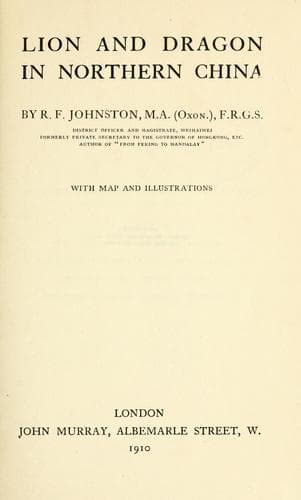
Lion and Dragon in Northern ChinaJohnston, Reginald Fleming, Sir
History
Lion and Dragon in Northern China
Johnston, Reginald Fleming, Sir
Weihai (China) -- History; Weihai (China) -- Social life and customs
An essential point in the Chinese conception of Filial Piety is that a
father's death does not set the son free from the obligations of duty
and reverence: it merely changes the outward form or expression of
those obligations. He can no longer watch over his father's physical
welfare and anticipate his material wants, but he can still bring
peace and happiness to his father's spirit by living an upright life
and bringing glory and prosperity to the family. If his abilities or
opportunities are not such as to enable him to earn for his father
posthumous honours (such as the Emperor confers upon the ancestors of
those who have deserved well of the State) it is probably within his
power to preserve intact the inherited property, to keep the family
temple and tombs in good repair, to carry out with propriety and
reverence the orthodox ancestral rites during his own lifetime and to
provide for their continuance during future generations by bringing up
a family of his own.
The Chinese belief with regard to the souls of the dead (or rather the
ancient beliefs on which the ancestral ceremonies are based) are rather
complicated. According to one doctrine every man has no less than ten
souls, of which three are _yang_ and seven are _yin_;[213] it is also
said that what is called the _hun-_soul goes to heaven, while the
_p'o_-soul descends into the earth. The most popular view appears to be
that every man has three souls allotted to him: of these one remains
in or around the tomb, another hovers about the ancestral tablet,
while the third wanders away and, after amalgamating itself with other
mysterious forces, is finally reincarnated in another mortal body,
which--unless the soul behaved very badly in its last incarnation--will
be a human one. For the purpose of the ancestral cult the souls
that are of importance are the grave-soul and the tablet-soul. The
grave-soul receives its due share of "worship" at the great annual
tomb-festivals of spring and autumn. The tablet-soul is supposed to
take up its abode, by ceremonious invitation, in the spirit-tablet
as soon as the body has been consigned to the grave. "From this very
moment," as Dr. De Groot says, "the tablet is considered to be imbued
with the afflatus of the dead, and to have become his perpetual
duplicate, to serve as a patron divinity in the domestic circle and
there to receive the offspring's sacrifices and worship."[214]
Public-domain text, read in full here on John Shaqi.
Reviews
Reviews
No reviews yet
Be the first to share your thoughts on this work.
Elsewhere in the archive
Join the Discussion
Join the discussion
Sign in to leave a comment or review.
Sign InorCreate an account