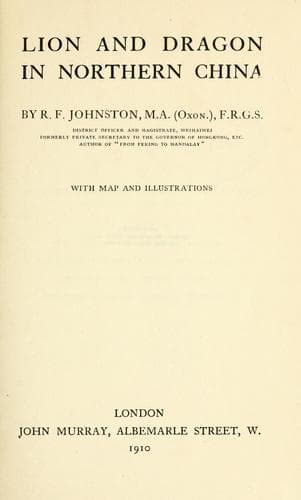
Lion and Dragon in Northern ChinaJohnston, Reginald Fleming, Sir
History
Lion and Dragon in Northern China
Johnston, Reginald Fleming, Sir
Weihai (China) -- History; Weihai (China) -- Social life and customs
Like many other hills in the neighbourhood and along the coast, it
possesses the remains of a stone-built beacon-tumulus (_fêng tun_),
on which signal fires were lighted in the old days of warfare. To the
northward lie Ku-mo Shan, the hill of Yao-yao, and Tiao-wo Shan, all
included in the range that bears in the British map the name of Admiral
Fitzgerald.
The highest point of the range is described in the local chronicle as
"a solitary peak, seldom visited by human foot," though it is nowadays
a common objective for European pedestrians, and also, indeed, for
active Chinese children. The height is barely one thousand feet above
sea-level. Tiao-we Shan and a neighbouring peak called Sung Ting Shan
were resorted to by hundreds of the inhabitants of Weihaiwei as a
place of refuge from the bands of robbers and disorganised soldiers
who pillaged the homes and fields of the people during the commotions
which marked the last year of the Ming dynasty (1643). To the northward
of the Huan-ts'ui-lou may be seen a little hill--not far from the
European bungalows at Narcissus Bay--crowned with a small stone obelisk
of a kind often seen in China and known to foreigners as a Confucian
Pencil. This was put up by a graduate of the present dynasty named
Hsia Shih-yen and others, as a means of bringing good luck to the
neighbourhood, and also, perhaps, as a memorial of their own literary
abilities and successes. It bears no inscription.
A loftier hill is Lao-ya Shan, which is or used to be the principal
resort of the local officials and people when offering up public
supplications for rain. Its name (which means the Hill of the Crows)
is derived from the black clouds which as they cluster round the
summit are supposed to resemble the gathering of crows. An alternative
name is Hsi-yü-ting--the Happy Rain Peak. The highest point in this
section of the Territory lies among the imposing range of mountains
to the south of Weihaiwei city, and is known to the Chinese as
Fo-erh-ting--"Buddha's Head"--the height of which is about 1,350 feet.
This range of hills has been named by the British after Admiral Sir
Edward Seymour.
Public-domain text, read in full here on John Shaqi.
Reviews
Reviews
No reviews yet
Be the first to share your thoughts on this work.
Join the Discussion
Join the discussion
Sign in to leave a comment or review.
Sign InorCreate an account