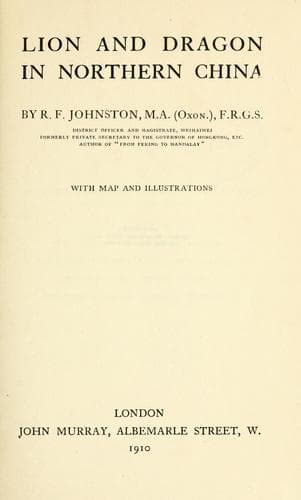
Lion and Dragon in Northern ChinaJohnston, Reginald Fleming, Sir
History
Lion and Dragon in Northern China
Johnston, Reginald Fleming, Sir
Weihai (China) -- History; Weihai (China) -- Social life and customs
The enumeration of all the hills of so mountainous a district as the
Weihaiwei Territory would be useless and of little interest. Some of
them, distinguished by miniature temples dedicated to the _Shan-shên_
(Spirit of the Hill) and to the Supreme God of Taoism, will be
referred to later on.[17] The loftiest hill in the Territory--about
1,700 feet--lies fourteen miles south of Port Edward, and is known to
Europeans as Mount Macdonald, and to the Chinese as Chêng-ch'i Shan or
Cho-ch'i Shan.[18] The Chinese name is derived from a stone chessboard
said to have been carved out of a rock by a _hsien-jên_, a kind of
wizard or mountain recluse who lived there in bygone ages. Most of
the more remarkable or conspicuous hills in China are believed by the
people to have been the abode of weird old men who never came to an end
like ordinary people, but went on living with absurdly long beards and
a profound knowledge of nature's secrets. There are endless legends
about these mysterious beings, many of whom were in fact hermits with
a distaste for the commonplace joys of life and a passion for mountain
scenery.[19]
On the rocky summit of the Li-k'ou hill (situated in the range of
which Fo-erh-ting is the highest point) there is a large stone which
is symmetrical in shape and differs in appearance from the surrounding
boulders. Legend says that a hermit who cultivated the occult arts
brewed for himself on the top of the hill the elixir of life. An ox
that was employed in grinding wheat at the foot of the hill sniffed
the fragrant brew and broke away from his tether. Rushing up the hill
in hot haste, he dragged after him the great grindstone. Arriving at
the summit, he butted against the cauldron in which the hermit had
cooked the soup of immortality, and eagerly lapped up the liquid as
it trickled down the side. The hermit, emulating an ancient worthy
called Kou Shan-chih who was charioted on the wings of a crane, jumped
on the ox's back, and thereupon the two immortal beings, leaving the
grindstone behind them as a memorial, passed away to heaven and were
seen no more. This is only one of many quaint stories told by the
old folks of Weihaiwei to explain the peculiar formation of a rock,
the existence of a cave in a cliff, or the sanctity of some nameless
mountain-shrine. Thus even the hills of Weihaiwei, bare of forests as
they are and devoid of mystery as they would seem to be, have yet their
gleam of human interest, their little store of romance, their bond of
kinship with the creative mind of man.
FOOTNOTES:
[5] The three characters in question are depicted on the binding of
this book.
Public-domain text, read in full here on John Shaqi.
Reviews
Reviews
No reviews yet
Be the first to share your thoughts on this work.
Join the Discussion
Join the discussion
Sign in to leave a comment or review.
Sign InorCreate an account