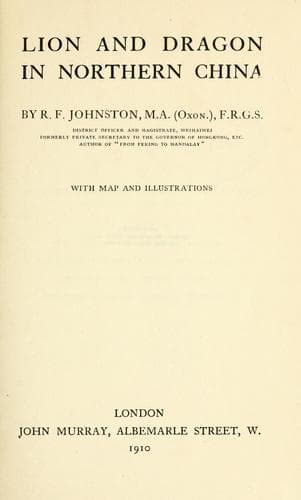
Lion and Dragon in Northern ChinaJohnston, Reginald Fleming, Sir
History
Lion and Dragon in Northern China
Johnston, Reginald Fleming, Sir
Weihai (China) -- History; Weihai (China) -- Social life and customs
This is a point of view which the Chinese--or at least those
who have not succumbed to the seductive whispers of Western
individualism--thoroughly understand and appreciate to this day. Cases
have been heard in the British courts at Weihaiwei which prove this
to be so. On the rare occasions when a father has been compelled to
bring an action against his son, or on the more numerous occasions when
a father is summoned to the court in connection with a criminal case
in which his own son is the accused, he frequently begins by making a
humble acknowledgment that his own failure to perform his duties as
father must at least partially account for his son's depravity; or if
in accordance with the Chinese practice the British magistrate sternly
lectures a father on the enormity of his offence in bringing up his
son so badly that the son has fallen into the clutches of the law,
the unhappy man admits the justice of the charge promptly and without
reserve. _Yü ts'o: ling tsui_,--"I am guilty: I accept punishment."
But the Chinese doctrine of filial piety does not concern itself only
with the relations between parent and child. We have seen that the
whole of Chinese society is regarded as a vast family of which the
Emperor is Father; similarly the territorial officials are _in loco
parentis_ to the heads of the families living within their respective
jurisdictions: they are the _fu-mu kuan_--the father-and-mother
officials.[327] The doctrine of _Hsiao_--Filial Piety--applies not only
to domestic relationships but also to the relations between Emperor
and Minister and between rulers and ruled. The head of a family who
disobeys an official proclamation is guilty of an offence towards
the local _fu-mu kuan_ which is almost identical in kind with the
offence of a son who wilfully disobeys his father. Here again the
responsibilities are not all on one side: the _fu-mu kuan_ is by the
higher authorities held theoretically responsible for the peace and
good order and contentment of the district over which he presides,
just as Confucius is said to have held the father responsible for the
misbehaviour of his son.
Public-domain text, read in full here on John Shaqi.
Reviews
Reviews
No reviews yet
Be the first to share your thoughts on this work.
Elsewhere in the archive
Join the Discussion
Join the discussion
Sign in to leave a comment or review.
Sign InorCreate an account