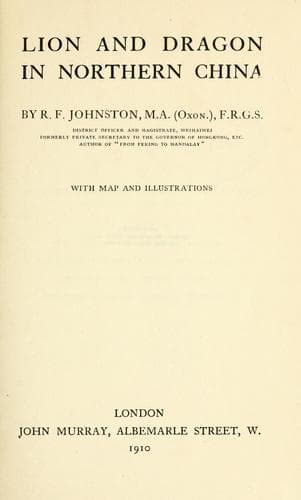
Lion and Dragon in Northern ChinaJohnston, Reginald Fleming, Sir
History
Lion and Dragon in Northern China
Johnston, Reginald Fleming, Sir
Weihai (China) -- History; Weihai (China) -- Social life and customs
Sometimes, indeed, this doctrine is carried too far, as when an
official is degraded for not preventing an outbreak of crime which he
could not possibly have foreseen. Western peoples have taken advantage
of this theory when they have called upon the Government to punish an
official within whose jurisdiction the slaughter of a missionary has
occurred, even when the official's complicity is quite unproved. The
people themselves know well that their officials are theoretically
responsible for their well-being, and often--through their lack of
scientific knowledge--blame their _fu-mu kuan_ for troubles which
the very best and most diligent of officials could not have averted.
The local officials--nay, viceroys of provinces and even the Emperor
himself--are regarded by their subordinates or subjects, or profess to
regard themselves, as personally responsible for such occurrences as
disastrous earthquakes, epidemics and inundations.[328] In 1909 the
appointment of a new governor to the province of Shantung happened
to be followed by a serious drought; he became highly unpopular at
once and received the disagreeable nickname of the Drought-Governor.
As recently as 1908 I passed through a district in the province of
Shansi in which no rain had fallen for several months. On entering
the magisterial town of the district I noticed that the streets
were thronged with crowds of people from the country, all wearing
willow-wreaths as a sign that the crops were threatened with
destruction and that public prayers were being offered for rain.[329]
The whole town was in confusion, and the sudden appearance of a
foreigner made matters worse. A noisy and restless crowd followed me
into my inn and proved so troublesome (though by no means violent) that
I was obliged to send a message to the local magistrate to request him
to have the inn-yard cleared. My messenger soon came back to report
that the magistrate's official residence or yamên was also closely
invested by a clamouring mob and that the wretched man had been obliged
to barricade his windows and doors to save himself from personal
violence. He was therefore powerless to grant my request. The crowd
had no complaint whatever against him except that his official prayers
for rain had failed to have the desired result and that his culpable
inability to establish friendly relations with the divine Powers was
the evident cause of the drought.
Public-domain text, read in full here on John Shaqi.
Reviews
Reviews
No reviews yet
Be the first to share your thoughts on this work.
Elsewhere in the archive
Join the Discussion
Join the discussion
Sign in to leave a comment or review.
Sign InorCreate an account