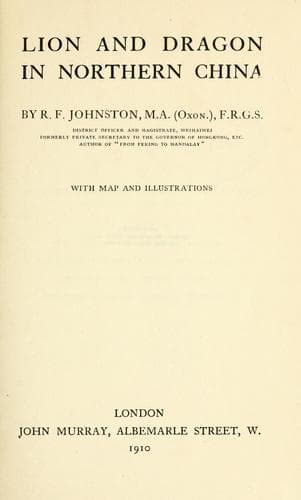
Lion and Dragon in Northern ChinaJohnston, Reginald Fleming, Sir
History
Lion and Dragon in Northern China
Johnston, Reginald Fleming, Sir
Weihai (China) -- History; Weihai (China) -- Social life and customs
[6] The following list of distances by sea to the principal
neighbouring ports may be of interest. The distance is in each case
reckoned from the Weihaiwei harbour. _Shantung Promontory_, 30 miles;
_Chefoo_, 42 miles; _Port Arthur_, 89 miles; _Dalny_, 91 miles;
_Chemulpo_, 232 miles; _Taku_, 234 miles; _Shanghai_ 452 miles;
_Kiaochou_, 194 miles; _Nagasaki_, 510 miles.
[7] "The magistrate is the unit of government; he is the backbone of
the whole official system; and to ninety per cent. of the population he
is _the_ Government."--Byron Brenan's _Office of District Magistrate in
China_.
[8] England and Wales contain 58,000 square miles, with a population
perhaps slightly less than that of Shantung.
[9] As early as the seventh century B.C. deforestation had become a
recognised evil in the State of Ch'i (part of the modern Shantung),
chiefly owing to the lavish use of timber for coffins and grave-vaults.
(_See_ De Groot's _Religious System of China_, vol. ii. pp. 660-1.)
[10] Especially some of the sea-beaches, the defiles that lie between
Yü-chia-k'uang and Shang Chuang, and the valleys in which are situated
Ch'i-k'uang, Wang-chia-k'uang, Pei k'ou, Chang-chia-shan, and Ch'ien
Li-k'ou.
[11] The story is quoted in the _T'ai P'ing Huan Yü Chi_ (_chüan_ 20).
[12] With regard to this assistance from spirits, cf. the Jewish legend
that King Solomon by the aid of a magic ring controlled the demons and
compelled them to give their help in the building of the great Temple.
[13] See _T'ai P'ing Huan Yü Chi_, _loc. cit._
[14] For accounts of other appearances of the "sea-serpent" in Chinese
waters, see Dennys's _Folk-lore of China_, pp. 109, 113-4.
[15] See pp. 53 and 36.
[16] _Shan_ is the Chinese word for "Hill."
[17] See pp. 391 _seq._
[18] See pp. 397-8.
[19] See pp. 393 _seq._
CHAPTER III
HISTORY AND LEGEND
Though Chinese historians have never set themselves to solve that
modern European problem as to whether history is or is not a science,
they have always--or at least since the days of Confucius--had a
strong sense of its philosophical significance and its didactic value.
Of the writings with which the name of Confucius is connected, that
known as the _Ch'un Ch'iu_ or "Spring and Autumn Annals" is the one
that he himself considered his greatest achievement, and Mencius
assures us that when the Master had written this historical work,
"rebellious ministers and bad sons were struck with terror." The
modern reader is perhaps apt to wonder what there was in the jerky,
disconnected statements of the _Ch'un Ch'iu_ to terrify any one,
however conscience-stricken; but Mencius's remark shows that history
was already regarded as a serious employment, well fitted to engage the
attention of philosophers and teachers of the people.
Public-domain text, read in full here on John Shaqi.
Reviews
Reviews
No reviews yet
Be the first to share your thoughts on this work.
Join the Discussion
Join the discussion
Sign in to leave a comment or review.
Sign InorCreate an account