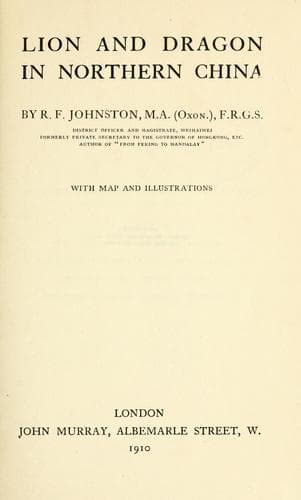
Lion and Dragon in Northern ChinaJohnston, Reginald Fleming, Sir
History
Lion and Dragon in Northern China
Johnston, Reginald Fleming, Sir
Weihai (China) -- History; Weihai (China) -- Social life and customs
For many centuries--and in this matter history and legend coincide--the
peninsular district of Shantung, including Weihaiwei, was inhabited
by a non-Chinese race of barbarians. Not improbably they were among
the aboriginal inhabitants of the central plains of China, who
were driven west, south and east before the steady march of the
invading Chinese, or--if we prefer to believe that the latter were an
autochthonous race--by the irresistible pressure of Chinese expansion.
The eastward-driven section of the aborigines, having been pressed into
far-distant Shantung, perhaps discovered that unless they made a stand
there they would be driven into the sea and exterminated; so they held
their ground and adapted themselves to the new conditions like the
Celts in Wales and Strathclyde, while the Chinese, observing that the
country was hilly, forest-clad, and not very fertile, swept away to the
richer and more tempting plains of the south-west.
This may or may not be a correct statement of what actually occurred:
all we know for certain is that at the dawn of the historical epoch
eastern Shantung was still inhabited by a people whom the Chinese
regarded as uncouth foreigners. The name given to them in the _Shu
Ching_ is Yü I, words which, if they are to be translated at all,
may be rendered as "the barbarians of the hill regions." The period
to which the _Shu Ching_ assigns them is that of the more or less
mythical Emperors Yao, Shun and Yü, whose reigns are assigned to the
twenty-third and twenty-fourth centuries B.C., the Chinese Golden Age.
An alternative view of the Yü I is that they were not the people of
eastern Shantung, but the inhabitants of one of the Japanese islands.
Dr. Legge, again, took the view that Ch'ing Chou, one of the nine
provinces into which the Emperor Yü divided the Empire, included
the modern kingdom of Korea. As the Yü I are always referred to as
inhabiting the most easterly portion of the Empire, Dr. Legge was
obliged to assign them to some part of the Korean peninsula[22];
following certain Chinese writers, moreover, he took Yü I to be a
place-name, though this surely can only have been by the transference
of the name or nickname of a people to their place of habitation. The
whole question is hardly worth discussing, for it is almost impossible
to disentangle fact from myth in respect of any of the alleged events
of that far-off age; though, on the whole, it seems improbable that
Yü's Empire--presuming that Yü was an historical personage--ever
extended as far as some patriotic Chinese commentators would like to
make out, or ever included any portion of either Korea or Japan. The
great K'ang Hsi dictionary definitely states that the Yü I country
"is the present Têng-chou," which includes the north-eastern section
of Shantung all the way to the Promontory. The dictionary also
describes it as "the place where the sun rises." An interesting point
in connection with the Yü I is that it was to their country that the
Public-domain text, read in full here on John Shaqi.
Reviews
Reviews
No reviews yet
Be the first to share your thoughts on this work.
Join the Discussion
Join the discussion
Sign in to leave a comment or review.
Sign InorCreate an account