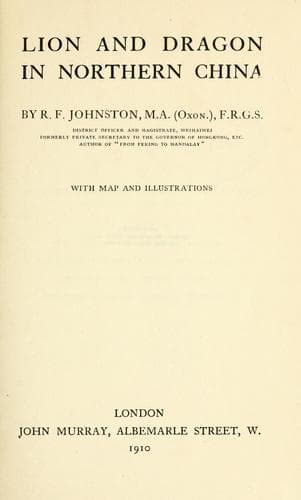
Lion and Dragon in Northern ChinaJohnston, Reginald Fleming, Sir
History
Lion and Dragon in Northern China
Johnston, Reginald Fleming, Sir
Weihai (China) -- History; Weihai (China) -- Social life and customs
Emperor Yao (2357 B.C.) is said to have sent one of the Imperial
Astronomers to "observe the heavens." The heavens of those days must
have been well worth observing, for Chinese legends say there were then
ten suns,[23] which all rose out of a prodigious abyss of hot water.
At one time, it was said, nine of the suns sat every day in the lower
branches of a great tree that grew in the land of Fu-sang, and one sat
on the topmost branch; but in the time of Yao all the suns climbed up
together to the top of the tree and made everything so uncomfortably
hot that the Emperor shot at them and succeeded in destroying nine.
Since then the world has had to content itself with a single sun.[24]
Assuming that the ordinary interpretations of the _Shu Ching_ are
correct, it appears that in the Golden Age of Yao the office of
Astronomer-Royal, as we should say, was an exclusive perquisite of
two families surnamed Hsi and Ho. Four members of these privileged
families were sent to establish observatories in the four quarters
of the Empire, east, west, south, and north, in order that they
might "deliver respectfully the seasons to the people." The passage
of the _Shu Ching_ in which this matter is mentioned[25] is of
great scientific interest on account of its astronomical details,
and of great importance as establishing the reliability of early
Chinese records. The only point that concerns us here is that one of
the astronomers--namely, the second of three of the privileged Ho
brothers--was sent to a tract of country called Yang Ku--"the Valley
of Sunlight"--in the territory of the Yü I. His special duty it was
to "receive as a guest the rising sun, and to adjust and arrange the
labours of the Spring." Monopoly and absence of competition seem
to have had their inevitable result; the privileged families of
Hsi and Ho fell into utter disgrace, and were charged with having
"neglected the ordering of the seasons and allowed the days to get
into confusion,"--and all this because they gave themselves up to the
pleasures of wine and female society instead of keeping a careful watch
on the movements of the heavenly bodies. The Hsi and Ho had evidently
become magnates of no small importance, for it was necessary to send
an army to punish them. Their main offence, as we gather from the _Shu
Ching_,[26] was that they made some sad blunder in connection with an
eclipse, and the penalty attached to an offence of this nature was
death. The only point with reference to all this that bears upon our
subject is that the eastern observatory, presided over by one of the Ho
family, was probably situated somewhere in the extreme eastern part of
the Shantung peninsula: and though it is open to sceptics to declare
that the astronomer, the observatory, and the Emperor himself were all
figments of the Chinese imagination, it is equally open to any one to
hold, though quite impossible for him to prove, that the Yang Ku--the
Public-domain text, read in full here on John Shaqi.
Reviews
Reviews
No reviews yet
Be the first to share your thoughts on this work.
Join the Discussion
Join the discussion
Sign in to leave a comment or review.
Sign InorCreate an account