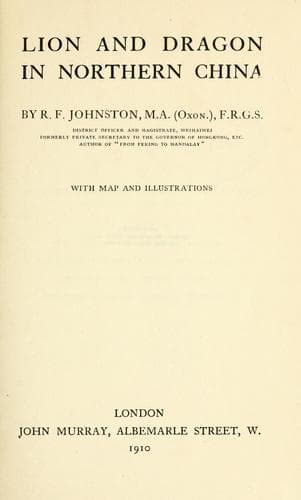
Lion and Dragon in Northern ChinaJohnston, Reginald Fleming, Sir
History
Lion and Dragon in Northern China
Johnston, Reginald Fleming, Sir
Weihai (China) -- History; Weihai (China) -- Social life and customs
hope that this little wilderness will prove to be of the kind that
blossoms like a rose, yet at least I shall escape the charge of having
staked out a valley and a hill and labelled it "China."
Hitherto Weihaiwei has been left in placid enjoyment of its bucolic
repose. The lords of commerce despise it, the traveller dismisses it
in a line, the sinologue knows it not, the ethnologist ignores it,
the historian omits to recognise its existence before the fateful
year 1895, while the local British official, contenting himself
with issuing tiny Blue-book reports which nobody reads, dexterously
strives to convince himself and others that its administrative
problems are sufficiently weighty to justify his existence and his
salary. And yet a few years of residence in this unpampered little
patch of territory--years spent to a great extent without European
companionship, when one must either come to know something of the
inhabitants and their ways or live like a mole--have convinced one
observer, and would doubtless convince many others, that to the
people of Weihaiwei life is as momentous and vivid, as full of joyous
and tragic interest, as it is to the proud people of the West, and
that mankind here is no less worthy the pains of study than mankind
elsewhere.
There is an interesting discovery to be made almost as soon as one
has dipped below the surface of the daily life of the Weihaiwei
villagers, and it affords perhaps ample compensation and consolation
for the apparent narrowness of our field of inquiry. In spite of their
position at one of the extremities of the empire, a position which
would seemingly render them peculiarly receptive to alien ideas from
foreign lands, the people of Weihaiwei remain on the whole steadfastly
loyal to the views of life and conduct which are, or were till
recently, recognised as typically Chinese. Indeed, not only do we find
here most of the religious ideas, superstitious notions and social
practices which are still a living force in more centrally-situated
parts of the Empire, but we may also discover strange instances of the
survival of immemorial rites and quasi-religious usages which are known
to have flourished dim ages ago throughout China, but which in less
conservative districts than Weihaiwei have been gradually eliminated
and forgotten. One example of this is the queer practice of celebrating
marriages between the dead. The reasons for this strange custom must
be dealt with later;[1] here it is only desirable to mention the fact
that in many other parts of China it appears to have been long extinct.
The greatest authority on the religious systems of China, Dr. De Groot,
whose erudite volumes should be in the hands of every serious student
of Chinese rites and ceremonies, came across no case of "dead-marriage"
during his residence in China, and he expressed uncertainty as to
whether this custom was still practised.[2] Another religious rite
Public-domain text, read in full here on John Shaqi.
Reviews
Reviews
No reviews yet
Be the first to share your thoughts on this work.
Join the Discussion
Join the discussion
Sign in to leave a comment or review.
Sign InorCreate an account