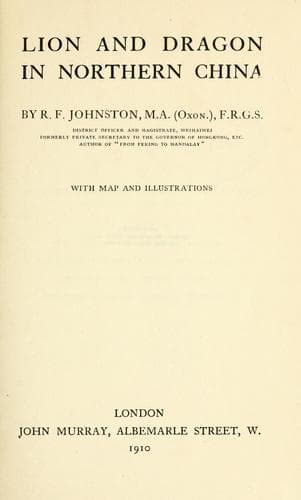
Lion and Dragon in Northern ChinaJohnston, Reginald Fleming, Sir
History
Lion and Dragon in Northern China
Johnston, Reginald Fleming, Sir
Weihai (China) -- History; Weihai (China) -- Social life and customs
which has died out in many other places and yet survives in Weihaiwei,
is that of burying the soul of a dead man (or perhaps it would be more
correct to say one of his souls) without his body.[3] Of such burials,
which must also be dealt with later on, Dr. De Groot, in spite of
all his researches, seems to have come across no instance, though he
confidently expressed the correct belief that somewhere or other they
still took place.[4]
As the people of Weihaiwei are so tenacious of old customs and
traditions, the reader may ask with what feelings they regard the
small foreign community which for the last decade and more has been
dwelling in their midst. Is British authority merely regarded as an
unavoidable evil, something like a drought or bad harvest? Does British
influence have no effect whatever on the evolution of the native
character and modes of thought? The last chapter of this book will be
found to contain some observations on these matters: but in a general
way it may be said that the great mass of the Chinese population
of Weihaiwei has been only very slightly, and perhaps transiently,
affected by foreign influences. The British community is very small,
consisting of a few officials, merchants, and missionaries. With two
or three exceptions all the Europeans reside on the island of Liukung
and in the small British settlement of Port Edward, where the native
population (especially on the island) is to a great extent drawn from
the south-eastern provinces of China and from Japan. The European
residents--other than officials and missionaries--have few or no
dealings with the people except through the medium of their native
clerks and servants. The missionaries, it need hardly be said, do not
interfere, and of course in no circumstances would be permitted to
interfere, with the cherished customs of the people, even those which
are branded as the idolatrous rites of "paganism."
Public-domain text, read in full here on John Shaqi.
Reviews
Reviews
No reviews yet
Be the first to share your thoughts on this work.
Join the Discussion
Join the discussion
Sign in to leave a comment or review.
Sign InorCreate an account