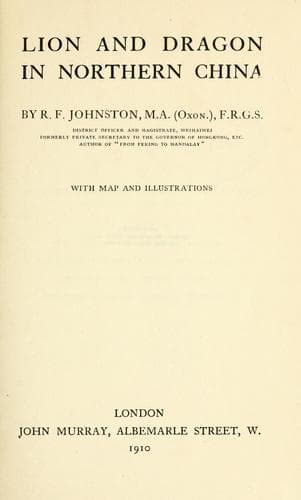
Lion and Dragon in Northern ChinaJohnston, Reginald Fleming, Sir
History
Lion and Dragon in Northern China
Johnston, Reginald Fleming, Sir
Weihai (China) -- History; Weihai (China) -- Social life and customs
The land-tax is based on the old land-registers handed over by the
Chinese magistrates of Wên-têng and Jung-ch'êng, and as they had been
badly kept up, or rather not kept up at all, for some scores of years
previously, the present relations between the land under cultivation
and the land subject to taxation are extremely indefinite. It is but
very rarely that a man can point to his land-tax receipts as proof
that he owns or has long cultivated any disputed area. Only by making
a cadastral survey of the whole Territory would it be possible to
place the land-tax system on a proper basis. At present the tax is in
practice (with certain exceptions) levied on each village as a whole
rather than on individual families. For many years past every village
has paid through its headman or committee of headmen a certain sum of
money which by courtesy is called land-tax. How that amount is assessed
among the various families is a matter which the people decide for
themselves, on the general understanding that no one should be called
upon to pay more than his ancestors paid before him unless the family
property has been considerably increased.
The Chinese Government did not and the British Government does not
make any close enquiries as to whether each cultivator pays his proper
proportion or whether a certain man is paying too much or is paying
nothing at all. It is undoubtedly true that a great deal of new land
has been brought under cultivation since the Chinese land-tax registers
were last revised, and that the cultivators are guilty of technical
offences in not reporting such land to Government and getting it duly
measured and valued for the assessment of land-tax: but these are
offences which have been condoned by the Chinese authorities in this
part of China for many years past, and it would be unjust or at least
inexpedient for the British Government to show greater severity in
such matters than is shown on the Chinese side of the frontier. The
British Government has, indeed, by a stroke of the pen doubled the
land-tax, that is, it takes twice as much from each village as it did
six years ago, so it may at least congratulate itself on deriving
a larger revenue from this source than used to come to the net of
Chinese officialdom. The total amount of the doubled tax only amounts
to about $24,000 (Mex.) a year, which is equivalent to not much more
than £2,000 sterling. The whole of this is brought to the coffers of
the Government without the aid of a single tax-collector and without
the expenditure of a dollar. In the autumn of each year proclamations
are issued stating the current rate of exchange as between the local
currency and the Mexican dollar and announcing that the land-tax will
be received, calculated according to that rate, upon certain specified
days. The money is brought to the Government offices at Port Edward by
the headmen, receipts are issued, and the matter is at an end until the
following year.
Public-domain text, read in full here on John Shaqi.
Reviews
Reviews
No reviews yet
Be the first to share your thoughts on this work.
Elsewhere in the archive
Join the Discussion
Join the discussion
Sign in to leave a comment or review.
Sign InorCreate an account