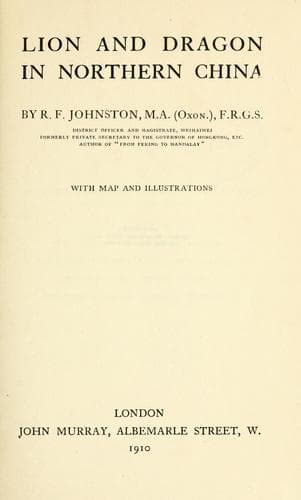
Lion and Dragon in Northern ChinaJohnston, Reginald Fleming, Sir
History
Lion and Dragon in Northern China
Johnston, Reginald Fleming, Sir
Weihai (China) -- History; Weihai (China) -- Social life and customs
The absence of Counsel is no hardship to the people, for in China
professional lawyers--as we understand the term--are unknown. "A man
who attempted to appear for another in a Court of Justice," as Sir
Robert Douglas says, "would probably render himself liable to a penalty
under the clause in the Penal Code which orders a flogging for any
person who excites or promotes litigation."[66] In Weihaiwei only
once has a native--in this case a Christian convert--made the least
attempt to conduct a case for and on behalf of another individual,
and he, though it was impossible under British methods to have him
flogged, was duly punished for this as well as for other offences.
In the courts of Weihaiwei, then, as in those of China, each of the
parties to a suit argues out his own case in his own way, though it
is upon the magistrate himself that the duty devolves of separating
the wheat from the chaff and selecting such parts of the litigant's
argument as appear to have a real bearing on the points at issue. In
all essentials, therefore, cases are heard and dealt with in Weihaiwei
very much as they are heard and dealt with in China; thus a man from
the Chinese side of the frontier who comes into court as plaintiff in
Weihaiwei finds himself--especially if he is used to litigation in his
own country--quite at home. As may be easily imagined, lawsuits are
not conducted with the frigid decorum that usually marks the hearing
of a civil case in England; the facts that plaintiff and defendant
appear in person, each to conduct his own case, and that each enjoys
practically unlimited freedom to say what he likes about his opponent
and about things in general, introduce a dramatic element which is
lacking in the more stately procedure of Western law-courts. Instead of
the patient discussion of minute points of law and the careful citation
of precedents and authorities, there are clamorous recitals of real or
imaginary woes, bitter denunciations, passionate appeals for justice.
A rather remarkable feature of all this, however, is the absence of
gesturing. Hands are not clasped or raised to heaven, the movements of
the body show no signs of deep feeling, even the features--though their
owner is inwardly seething with emotion--seem to remain almost passive.
Is this a sign of remoteness from savagery? The people of England
have been singled out as examples of those who make a minimum use of
gesture: but Englishmen cannot be compared in this respect with the
Chinese.
Public-domain text, read in full here on John Shaqi.
Reviews
Reviews
No reviews yet
Be the first to share your thoughts on this work.
Elsewhere in the archive
Join the Discussion
Join the discussion
Sign in to leave a comment or review.
Sign InorCreate an account