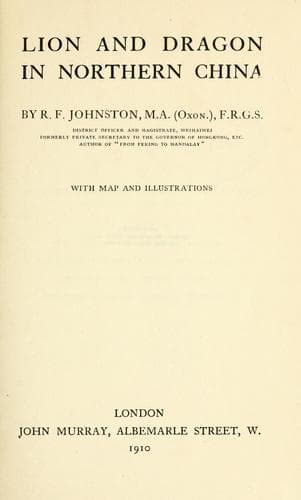
Lion and Dragon in Northern ChinaJohnston, Reginald Fleming, Sir
History
Lion and Dragon in Northern China
Johnston, Reginald Fleming, Sir
Weihai (China) -- History; Weihai (China) -- Social life and customs
The magistrate is supposed to be a kind of living embodiment of all
the Confucian virtues, and therefore to look with extreme favour on
any one whose words or conduct show him to be dutiful to his father,
punctilious in serving the spirits of the dead, respectful to old
age, a wise and good parent, industrious, honest in his dealings with
his neighbours, and law-abiding. No litigant neglects an opportunity
of showing that he possesses each and all of these qualities; and
sometimes it is done cleverly and with an appearance of artlessness. A
man brought an action against another for debt. In the course of his
statement he said: "Whenever I demand the money from him he reviles
me. (Cross-examined). I never reviled him in return. I didn't dare to
do so because he had a beard and I had none. How could I dare to revile
a man with a beard?" This of course means in plain language, "He was my
elder, and therefore I with my well-known regard for the proprieties
could not presume to answer him back." It is not usual in China for a
man to grow a beard or moustache until he has reached middle age.
A litigant also tries to ingratiate himself with the magistrate by
an affectation of extreme humility. A villager is asked if he can
write. He says no. When it is subsequently discovered that he can read
and write with fluency and he is taxed with his falsehood, he merely
explains that he did not dare to boast of his accomplishments in the
presence of the magistrate. The meaning is that the magistrate's
scholarly attainments are (theoretically) so overwhelmingly brilliant
that the litigant's own poor scraps of learning sink into utter
nothingness by comparison. In other words, it is politeness and
humility that impel the man to say he cannot write.
Among the cases that cause the greatest difficulty and sometimes
embarrassment to an English magistrate are those that turn on some
foolish old custom or deeply-rooted superstition. Sometimes it happens
that by deciding the case one way the magistrate may be upholding a
popular view at the cost of doing violence to his own feelings of what
is right and proper; by deciding it in another way he may provoke a
strong local feeling of resentment against the ignorant judgments of
foreigners who do not understand the ways of the people. As a rule
it is best to ascertain the views of the oldest and most respectable
members of the village or district concerned, and give judgment
accordingly. It is interesting to observe that the old folks will not
in all cases give their vote for the pro-superstition view. A lawsuit
of the kind referred to arose recently out of a dispute in a village
as to the digging of a well. The plaintiffs petition ran as follows:
Public-domain text, read in full here on John Shaqi.
Reviews
Reviews
No reviews yet
Be the first to share your thoughts on this work.
Elsewhere in the archive
Join the Discussion
Join the discussion
Sign in to leave a comment or review.
Sign InorCreate an account