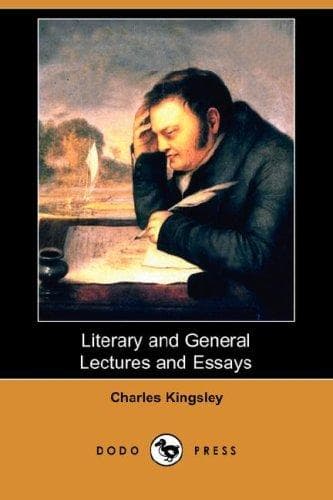
Literary and General Lectures and EssaysKingsley, Charles
History
Literary and General Lectures and Essays
Kingsley, Charles
English literature -- History and criticism
And it is most noteworthy that in this age, in which there is more
knowledge than there ever was of what man has been, and more
knowledge, through innumerable novelists, and those most subtle and
finished ones, of what man is, that poetry should so carefully avoid
drawing from this fresh stock of information in her so-confident
horoscopes of what man will be.
There is just now as wide a divorce between poetry and the common-
sense of all time, as there is between poetry and modern knowledge.
Our poets are not merely vague and confused, they are altogether
fragmentary--disjecta membra poetarum; they need some uniting idea.
And what idea?
Our answer will probably be greeted with a laugh. Nevertheless we
answer simply, What our poets want is faith.
There is little or no faith nowadays. And without faith there can be
no real art, for art is the outward expression of firm coherent
belief. And a poetry of doubt, even a sceptical poetry, in its true
sense, can never possess clear and sound form, even organic form at
all. How can you put into form that thought which is by its very
nature formless? How can you group words round a central idea when
you do not possess a central idea? Shakespeare in his one sceptic
tragedy has to desert the pure tragic form, and Hamlet remains the
beau-ideal of "the poetry of doubt." But what would a tragedy be in
which the actors were all Hamlets, or rather scraps of Hamlets? A
drama of Hamlet is only possible because the one sceptic is
surrounded by characters who have some positive faith, who do their
work for good or evil undoubtingly while he is speculating about his.
And both Ophelia, and Laertes, Fortinbras, the king, yea the very
grave-digger, know well enough what they want, whether Hamlet does or
not. The whole play is, in fact, Shakespeare's subtle reductio ad
absurdum of that very diseased type of mind which has been for the
last forty years identified with "genius"--with one difference,
namely, that Shakespeare, with his usual clearness of conception,
exhibits the said intellectual type pure and simple, while modern
poets degrade and confuse it, and all the questions dependent on it,
by mixing it up unnecessarily with all manner of moral weaknesses,
and very often moral crimes.
Public-domain text, read in full here on John Shaqi.
Reviews
Reviews
No reviews yet
Be the first to share your thoughts on this work.
Join the Discussion
Join the discussion
Sign in to leave a comment or review.
Sign InorCreate an account