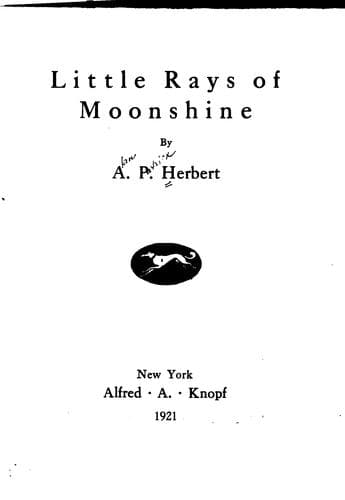
Little rays of moonshineHerbert, A. P. (Alan Patrick)
General
Little rays of moonshine
Herbert, A. P. (Alan Patrick)
English essays -- 20th century; English wit and humor
Close beside us a couple fell down with a great crash. I looked at
them with concern, but no one else took any notice. On with the dance!
Faster and faster the black men played. I was dimly aware now that
they were standing on their chairs, bellowing, and fancied the end
must be near. Then we were washed into a quiet backwater, in a corner,
and from here I determined never to issue until the Last Banjo should
indeed sound. Here I sidled vaguely about for a long time, hoping that
I looked like a man preparing for some culminating feat, a side-step or
a buzz or a double Jazz-spin or an ordinary fall down.
The noise suddenly ceased; the four black men had exploded.
“Very good exercise,” my partner said.
“Quite,” said I.
The Autobiography
John Antony Grunch was one of the mildest, most innocent men I ever
knew. He had a wife to whom he was devoted with a dog-like devotion;
he went to church; he was shy and reserved, and he held a mediocre
position in a firm of envelope-makers in the City. But he had a
romantic soul, and whenever the public craving for envelopes fell
off--and that is seldom--he used to allay his secret passion for
danger, devilry and excitement by writing sensational novels. One of
these was recently published, and John Antony is now dead. The novel
did it.
Yet it was a very mild sort of “shocker,” about a very ordinary murder.
The villian simply slew one of his typists in the counting-house with a
sword-umbrella and concealed his guilt by putting her in a pillar-box.
But it had “power,” and it was very favourably reviewed. One critic
said that “the author, who was obviously a woman, had treated with
singular delicacy and feeling the ever-urgent problem of female
employment in our great industrial centres.” Another said that the
book was “a brilliant burlesque of the fashionable type of detective
fiction.” Another wrote that “it was a conscientious analysis of a
perplexing phase of agricultural life.” John thought that must refer to
the page where he had described the allotments at Shepherd’s Bush. But
he was pleased and surprised by what they said.
Public-domain text, read in full here on John Shaqi.
Reviews
Reviews
No reviews yet
Be the first to share your thoughts on this work.
Join the Discussion
Join the discussion
Sign in to leave a comment or review.
Sign InorCreate an account